Cahaba: Alabama’s First Permanent State Capital
Site at a Glance
- Popularity
- Very High
- Country
- United States
- Primary era
- Modern
- Eras represented
- Modern
- Civilizations
- Unclassified
- Site type
- City
On this page12 sections
History
Capital of Alabama
Cahaba was a planned town at the meeting of the Alabama and Cahaba rivers in Alabama, United States, and served as the state’s first permanent capital from 1820 to 1825. The name, also spelled Cahawba, is thought to combine Choctaw words for water and above. A commission formed at St. Stephens on February 13, 1818, to choose the capital’s location, and Cahaba’s selection was approved on November 21.
In October 1819, Governor William Wyatt Bibb reported that the town had been laid out and its lots would be auctioned. Because the capital was not yet ready, Alabama’s constitutional convention met temporarily in Huntsville while a statehouse was built. Cahaba was functioning as the capital by 1820. Critics objected to its low-lying location, seasonal floods, and reputation for disease attributed to unhealthy air. In January 1826, the legislature approved moving the capital to Tuscaloosa; it moved again to Montgomery in 1846. The loss of the state government and related business weakened Cahaba.
Cotton trade and the Civil War
Cahaba remained the Dallas County seat for several decades. Cotton trade helped restore its commercial and social life, as the town became a distribution point for cotton carried down the Alabama River to Mobile. A railroad connection in 1859 encouraged a building boom. In 1860, about 2,000 people lived in Cahaba, around 64 percent of them African American. Dallas County was about 75 percent Black, and many enslaved people worked on cotton plantations. Free people of color in Cahaba were prominent in the poultry trade.
During the Civil War, the Confederate government took Cahaba’s railroad rails to extend a nearby line considered more important for military purposes. It enclosed a large cotton warehouse for use as a prison, where Castle Morgan held Union prisoners of war from 1863 to 1865. A major flood in February 1865 compounded the hardship of residents and roughly 3,000 prisoners. During the war, Confederate General Nathan Bedford Forrest and Union General James H. Wilson met at the Crocheron mansion to discuss exchanging prisoners captured during the Battle of Selma.
After the flood, the legislature transferred the Dallas County seat to better-situated Selma in 1866. Businesses and residents followed, and Cahaba declined rapidly.
Reconstruction and political change
During Reconstruction, the post-Civil War period of political and social change, formerly enslaved people organizing in the Republican Party met regularly in Cahaba’s vacant county courthouse as they sought to protect their political gains. They and their families gradually turned empty blocks into fields and gardens, but later left. By 1870, the town had 431 residents, including 302 Black residents.
Jeremiah Haralson represented Cahaba and Dallas County in the Alabama House, the state Senate, and the U.S. Congress. During Reconstruction, he was the only African American in Alabama elected to all three bodies. In 1876, fraud by General Charles M. Shelley, the Dallas County sheriff, prevented Haralson’s reelection.
Abandonment and preservation
Before 1900, a formerly enslaved man bought most of the old town site for $500. He arranged for abandoned buildings to be dismantled and their materials shipped by steamboat to Mobile and Selma. By 1903, most of Cahaba’s buildings were gone, and only a handful of structures remained beyond 1930. Cahaba appeared on U.S. census rolls from 1860 through 1880 and remained incorporated as late as 1989.
Ghost stories about Cahaba circulated during the nineteenth and twentieth centuries. One well-known tale described a ghostly orb in the garden maze at C. C. Pegues’s home and was included in 13 Alabama Ghosts and Jeffrey. The uninhabited site is maintained by the Alabama Historical Commission as Old Cahawba Archeological Park. It was added to the National Register of Historic Places, the federal register of sites recognized for their historical importance, in 1973.
Remains
Town plan and landscape
The former town site covers 853 acres of low ground at the meeting of the Alabama and Cahaba rivers. Cahaba was laid out on a grid, with north-south streets named for trees and east-west streets named for famous men. Abandoned streets, cemeteries, and ruins remain within the former town site.
Public and residential buildings
Statehouse
The statehouse stood near Vine and Capitol streets. It was a two-story brick building, 43 feet (13 m) wide and 58 feet (18 m) long.
Mansions and quarters
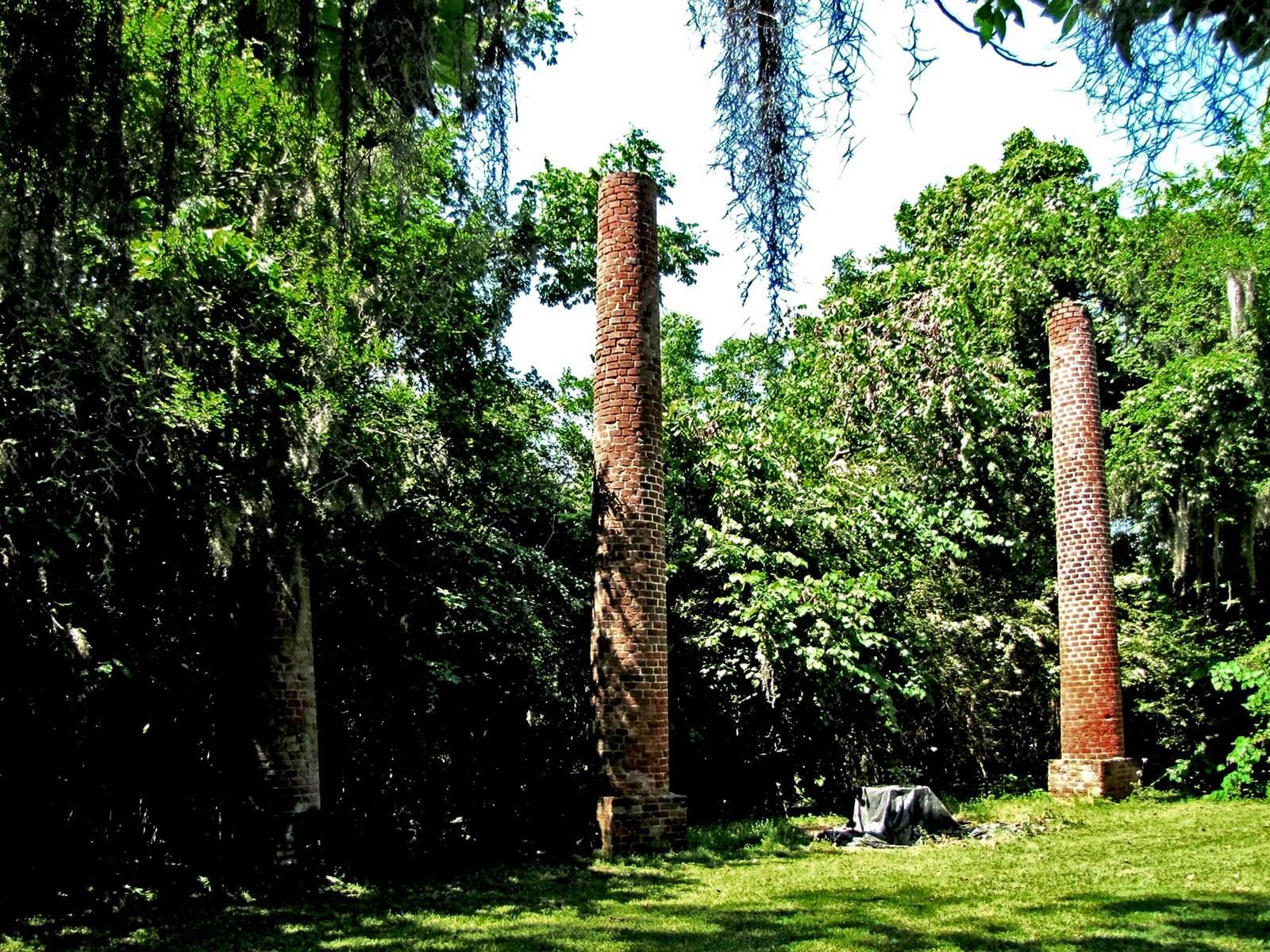
Successful planters and merchants built two-story mansions in Cahaba. The 26-room Perine Mansion stood on Vine Street and was built in the 1850s. Merchant and planter Edward Martineau Perine owned both the mansion and the Perine Store. The Crocheron mansion, built in 1843, burned in the early twentieth century. On Oak Street, the Kirkpatrick mansion burned in 1935; the two-story brick quarters for enslaved people behind it remained intact.
Churches and academy
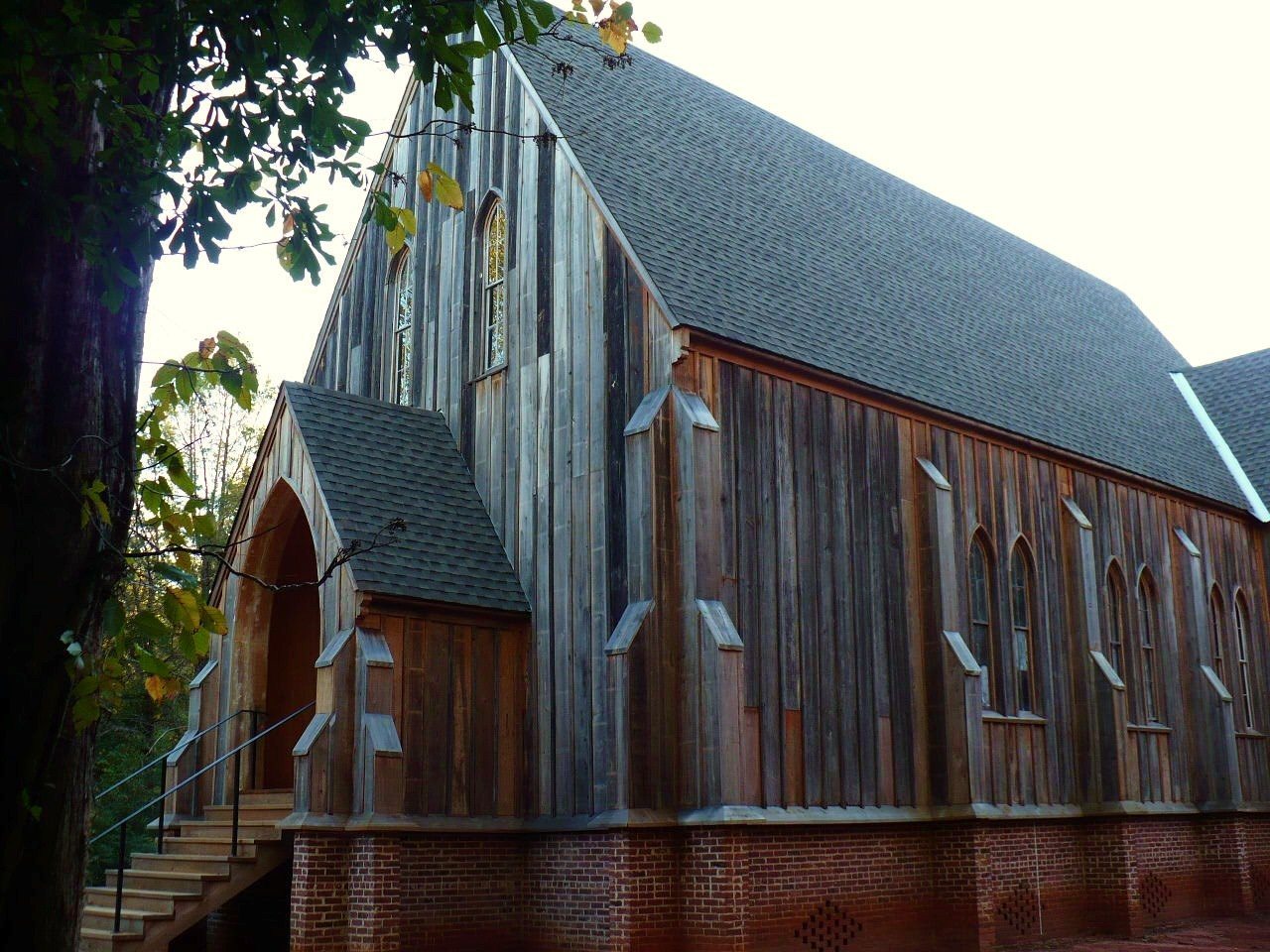
St. Luke’s Episcopal Church was built in 1854 to a design by the prominent American architect Richard Upjohn. It was moved to Martin’s Station in 1878 and stood there in 1934, about 15 miles (24 km) from Cahaba, before returning to Old Cahawba in the early twenty-first century. A Methodist church was photographed in the 1930s and later destroyed by fire. A women’s academy was also among Cahaba’s buildings.
Castle Morgan
Along Arch Street, on the riverbank, a defensive enclosure surrounded a large cotton warehouse to form Castle Morgan. The warehouse and its enclosing stockade made up the prison complex.