Fort Sumner: A U.S. Army Post and Bosque Redondo Site
Site at a Glance
- Country
- United States
- Primary era
- Modern
- Eras represented
- Modern
- Civilizations
- Unclassified
- Site type
- Military
- Remains
- Fort
On this page11 sections
History
Fort Sumner was a United States Army fort at Bosque Redondo beside the Pecos River in present-day De Baca County, New Mexico, United States. Built in 1862, it served as a supply depot and was intended to protect settlers in the Pecos valley from Mescalero Apache, Kiowa, and Comanche people. Nearby, the Army established a reservation where Navajo and Mescalero Apache people were forcibly confined.
The fort and the Bosque Redondo plan
The name Bosque Redondo means “round forest.” Spanish explorers Francisco Vázquez de Coronado and Antonio de Espejo passed through the area in 1541 and 1583. A trading post opened there in 1851 to support trade with Apache and Comanche people.
In 1862, General James Henry Carleton proposed creating a reservation at Bosque Redondo and building a nearby fort. He presented the reservation as a way to relocate Navajo and Mescalero Apache people and establish a self-supporting agricultural community. His aim was also to remove them from lands where he expected to find valuable minerals, especially gold and silver. Congress authorized the fort’s construction on October 31, 1862. It was named for Edwin Vose Sumner, Carleton’s former commander.
New Mexico Governor Henry Connelly and Indian agent James L. Collins backed the plan. An Army inspection commission, however, warned that the location was far from supply depots, that the Pecos water contained harmful minerals, and that spring floods often affected the valley. It recommended choosing another site, but Carleton continued with his proposal.
Forced removal and confinement
Carleton ordered Army officer Kit Carson to bring Mescalero Apache people, and later Navajo people, to Bosque Redondo by force. In March 1863, Carson’s troops imprisoned several hundred Mescalero at Fort Sumner; about 100 others fled to Mexico. A separate force was sent against the Gila Apache. The removal of Navajo people took longer. After a meeting with Navajo leaders at Fort Wingate failed in April 1863, Carleton demanded their surrender by July 20.
Carson’s campaign against the Navajo destroyed villages and crops and took or killed livestock. In January 1864, his troops entered Canyon de Chelly, where they destroyed food stores, a village, livestock, and an orchard of several thousand peach trees. These losses, along with winter conditions, weakened resistance, and Navajo people began surrendering. The Long Walk, the forced removal of Navajo people from their homeland to Bosque Redondo, began in 1864. More than 300 people died during the journey.
From March 1864, Navajo people gathered at Fort Canby and Fort Wingate were compelled to travel about 500 kilometers to Bosque Redondo. By April 1865, about 8,500 Navajo and 500 Mescalero Apache were held there, although the Army had planned for only 5,000 people. The two peoples had a history of raiding and hostility, and their forced confinement together brought frequent conflict. Navajo people were barred from speaking their language and practicing their cultural customs. Food was scarce, alkaline water from the Pecos caused intestinal illness, and disease spread. Firewood also ran short as the cottonwoods along the river were quickly used up.
Hardship and growing opposition
Carleton’s plan for agricultural self-sufficiency faltered. Estimates of cultivable land increased from about 4,000 to 6,000 acres, and roughly 3,000 acres were planted with corn and wheat in summer 1864. Moth larvae damaged the corn and storms ruined the wheat, forcing the Army to ration food to avert famine. Pest damage returned in 1865; drought and hail reduced harvests in 1866 and 1867, and the 1867 crop failed. The community remained dependent on government supplies, which cost about $62,000 a month.
About 900 Navajo people escaped in April 1865, and more escapes followed. That August, Carleton ordered that any Indigenous person found outside the reservation without authorization be killed. In November, Mescalero Apache people strong enough to travel escaped to the Sacramento Mountains south of Bosque Redondo.
Indian agent and physician Michael Steck, who had initially supported the plan, opposed it after concluding that Carleton had underestimated the Navajo population and overestimated the amount of fertile land. Steck urged that the Navajo be allowed a reservation in their own territory rather than be confined alongside the Mescalero Apache, but Carleton rejected his objections. Criticism grew among federal and New Mexico officials. The Interior Department sent Julius K. Graves to investigate in December 1865, and in December 1866 responsibility for Bosque Redondo passed from the Army to the Bureau of Indian Affairs, the federal agency responsible for government relations and services involving Indigenous peoples. Carleton left his command in April 1867 and General George W. Getty replaced him.
Treaty and departure
As costs mounted and congressional funding for Navajo support ran out, Indian Affairs Commissioner Nathaniel Green Taylor warned Interior Secretary O. H. Browning that conditions were making the Navajo increasingly unsettled. On July 20, 1867, Congress established a commission to negotiate peace treaties with Indigenous nations west of the Mississippi. Taylor chaired the commission, which reported to the President on January 7, 1868, and sought authority to negotiate the Navajo departure. Senator John B. Henderson introduced a bill for that purpose on March 10.
In April 1868, Navajo leaders met President Andrew Johnson in Washington. The commission sent General William T. Sherman and Colonel Samuel F. Tappan to Fort Sumner to negotiate; they arrived on May 27, and the council began the next day. Barboncito and six other Navajo leaders took part. Since no interpreter could translate directly between Navajo and English, one translated into Spanish and another from Spanish into English.
Sherman proposed moving the Navajo to a reservation in Oklahoma, but Barboncito rejected the proposal. Navajo leaders insisted on returning to their ancestral lands, and Tappan helped secure agreement to a reservation in their former territory between the Rio Grande and the Little Colorado. After discussing its boundaries and reviewing the terms, the parties signed the treaty on June 1, 1868.
On June 18, about 7,300 Navajo people left Bosque Redondo for the new reservation. They traveled with 1,500 horses and mules, 2,000 sheep, 50 Army wagons, and a cavalry escort. The first arrived near Fort Defiance in late July. Fort Sumner was abandoned in 1869.
Later history and recognition
Rancher Lucien Maxwell bought the fort property in 1869. On July 14, 1881, Sheriff Pat Garrett shot and killed Billy the Kid, the outlaw name of William H. Bonney, in a house on the property. Maxwell’s daughter Paulita was a friend of Billy the Kid.
Fort Sumner became a New Mexico State Monument in 1968, entered the New Mexico State Register of Cultural Properties in 1970, and was added to the National Register of Historic Places, the federal register of historic properties, in 1974. Congress authorized the Bosque Redondo Memorial in 2000, and its museum opened at the historic site on June 4, 2005.
Remains
The historic property lies along the Pecos River at Bosque Redondo, in present-day De Baca County southeast of the modern town of Fort Sumner. It includes the fort grounds, a residence formed from one of the fort’s quarters, and the Bosque Redondo Memorial museum.
Historic structures and memorial
Fort grounds
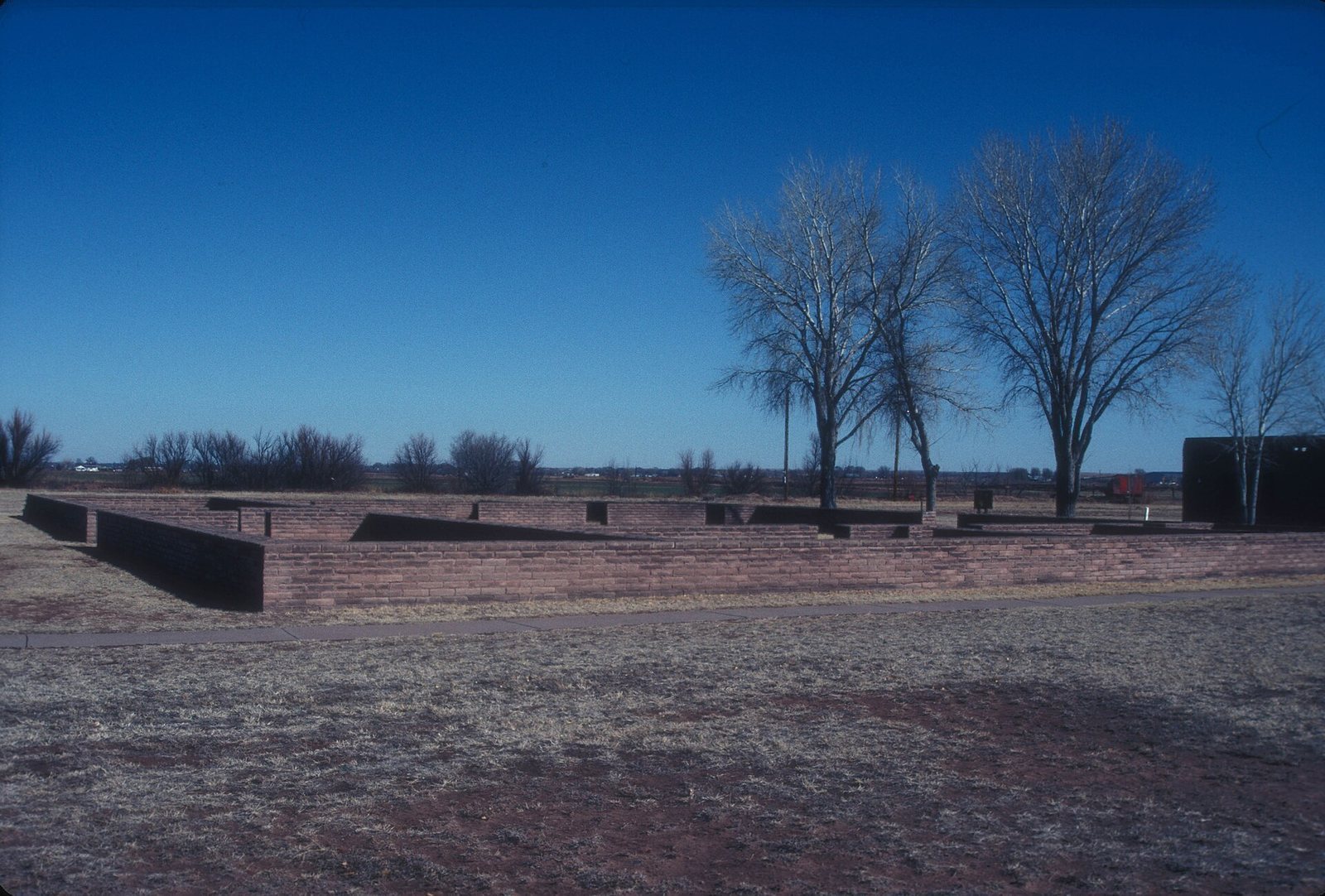
The historic property covers 50 acres (20 hectares) and is identified as the Fort Sumner Ruins.
Maxwell House
One of the fort’s officers’ quarters was rebuilt as a 20-room residence, known as Maxwell House.
Bosque Redondo Memorial
The Bosque Redondo Memorial is a museum located at the historic site.