Fort William and Mary: A Colonial Coastal Fort in New Hampshire
Site at a Glance
- Country
- United States
- Primary era
- Modern
- Eras represented
- Medieval, Modern
- Civilizations
- English
- Site type
- Military
- Remains
- Fort
On this page14 sections
History
Colonial fort and the Revolution
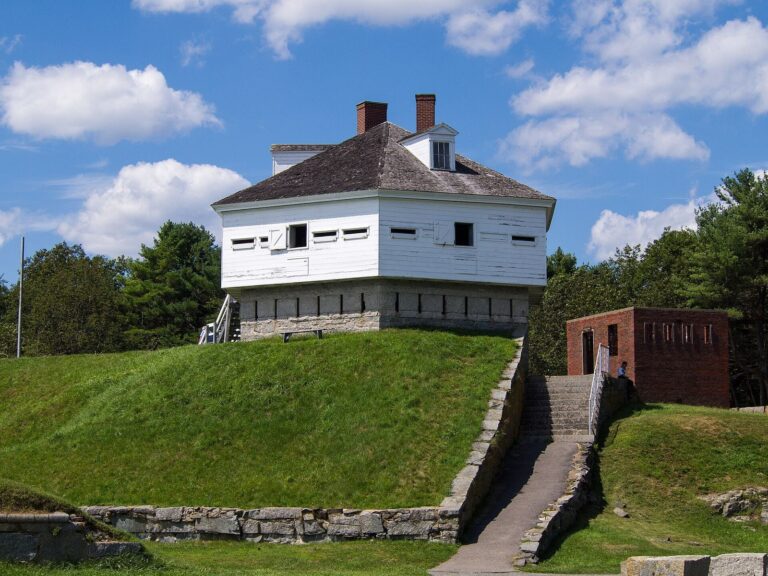
Fort William and Mary was a British colonial fort at the mouth of the Piscataqua River in present-day New Castle, New Hampshire, United States. Its first defenses were erected by 1632 to guard Portsmouth Harbor, and the fort became the colony’s main munitions depot and seaport, reporting directly to the royal governor. The initial earthwork, armed with four guns, was intended in part to protect the settlement from the pirate Dixie Bull.
In 1665, a royal commission, a body appointed by the Crown to investigate colonial affairs, recommended major improvements. The Second Anglo-Dutch War, a conflict between England and the Dutch Republic from 1665 to 1667, was one reason for the proposals. Dover and Portsmouth financed the work, and a wooden blockhouse followed in 1666. Richard Cutt took command of the renovated fort in 1673, with Elias Stileman as his lieutenant. After Cutt’s death in 1676, Stileman became commander. Governor Edward Cranfield replaced him with Walter Barefoote in 1683.
Following Gove’s Rebellion, rebel Edward Gove was held at the fort before being sent to Boston and then the Tower of London. He complained about Barefoote’s treatment of him. Shadrach Walton commanded the fort during several periods around the turn of the eighteenth century. The fort also guarded Kittery, across the harbor in the neighboring British colony of Massachusetts Bay, where Wabanaki forces repeatedly raided during the French and Indian Wars. The Wabanaki Confederacy was an alliance of Indigenous peoples in northeastern North America.
During King William’s War, a late-seventeenth-century conflict involving English and French colonial forces and their Indigenous allies, the fort received guns and other equipment from England. In 1692 it took the name Fort William and Mary, honoring William III and Mary II, joint monarchs of England, Scotland, and Ireland. Military architect Wolfgang William Romer inspected the site in 1705 and proposed improvements that were not made. A lighthouse was established at the fort in 1771, with its first light tended by the small garrison.
In 1774, the fort was New Hampshire’s only permanently occupied military post. After Patriot messenger Paul Revere warned that the British intended to garrison it, more than 400 people from Portsmouth, Rye, and New Castle, led by John Langdon, attacked on December 14. They overcame the six-person British caretaker detachment and seized about five tons of gunpowder for local militias. The following day, a second group led by John Sullivan took 16 guns, ammunition, and supplies. These actions were New Hampshire’s first rebellion and among the opening events of the American Revolution.
British reinforcements arrived aboard the sloop Canceaux on December 17 and the 40-gun frigate Scarborough on December 19. A force of 100 marines then occupied the fort. In the summer of 1775, royal governor John Wentworth and his family took refuge there for two months. After the British evacuated, Wentworth and his family sailed to Boston aboard the Scarborough on August 24. He returned briefly about a month later to issue a proclamation, but British rule in New Hampshire had ended. Sullivan’s militia destroyed what the British had left and built Fort Washington and Fort Sullivan upriver.
Federal fortification and nineteenth-century use
After the Revolution, the site was also known as Castle Fort or Fort Castle. A small United States garrison arrived in 1783, and the rearmed fort served as a customs post at the harbor entrance. New Hampshire transferred the fort and lighthouse to the federal government in 1791. The Portsmouth Naval Shipyard was established upriver in 1800. In response to increasing British hostilities, the fort was rebuilt in the early nineteenth century and was known as Fort Constitution by 1808. An accidental explosion there on July 4, 1809, killed soldiers and civilians.
Fort Constitution was occupied and expanded during the War of 1812. Its outer walls were extended in 1840, and the garrison was withdrawn in 1852; the site was then used as a training camp. A new fortification under the Third System, a United States program for building coastal defenses, began in 1862. Work stopped in 1867 as advances in artillery and armored steam-powered warships made masonry defenses obsolete. The fort was garrisoned again during the Civil War, and four Parrott guns installed during that era remained until they were scrapped in 1905. The garrison left in 1874, leaving a caretaker.
Modern coastal defenses and state historic site
The Endicott program, a late-nineteenth-century modernization of United States coastal defenses, brought new gun positions to the fort. Battery Farnsworth was built from 1897 to 1899, followed by Battery Hackleman in 1904 to help protect an underwater minefield. The harbor entrance was first mined during the Spanish-American War in 1898. In October 1917, Battery Farnsworth’s 8-inch guns were removed for intended railway-artillery service. They remained in an arsenal and were not sent overseas. A mine casemate and fire-control equipment were installed in 1920, and the fort entered reserve status in 1922. In 1938, part of the old fort wall was taken down and reused as shoreline protection.
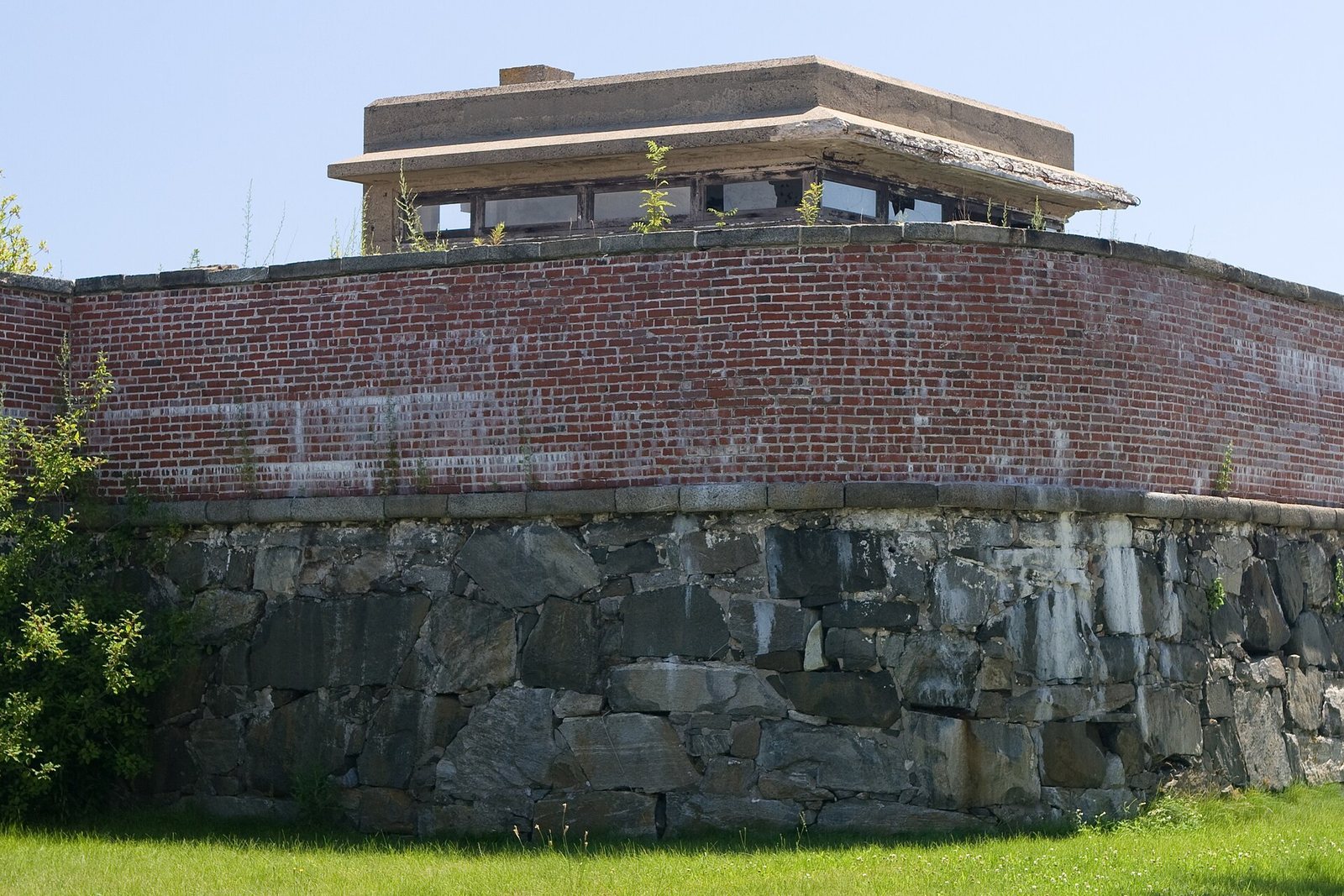
During World War II, the harbor was mined again and the fort served as a mine store. The 22nd Coast Artillery Regiment manned the harbor defenses from 1940 to 1944, and a mine-observation station was built atop Battery Farnsworth. Battery Hackleman was disarmed by 1948. After the war, the site left Army control; the New Hampshire National Guard used it for training until 1958. The military transferred the site to New Hampshire in 1961, and it became a state park and historic site. It was added to the National Register of Historic Places in 1973.
Remains
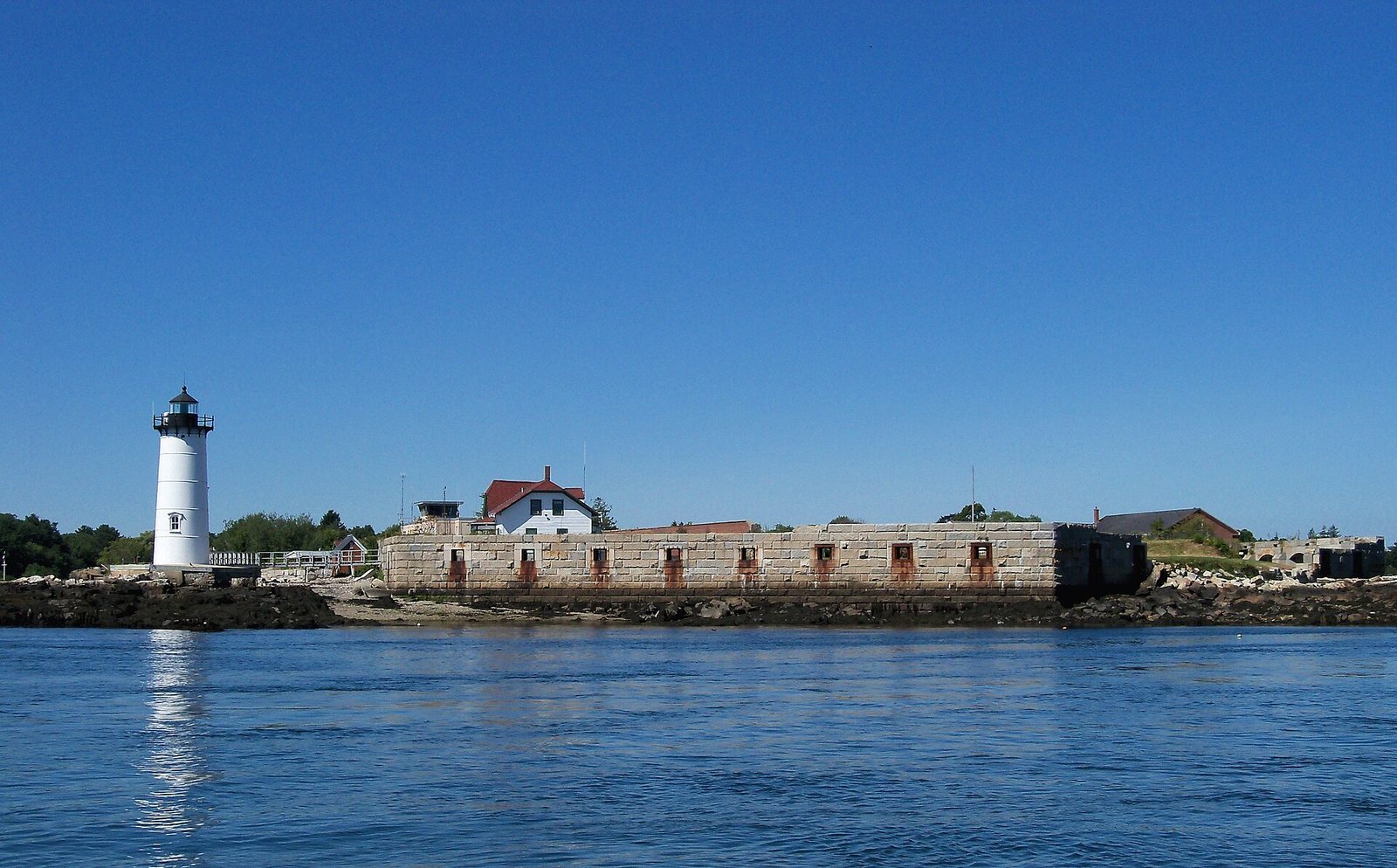
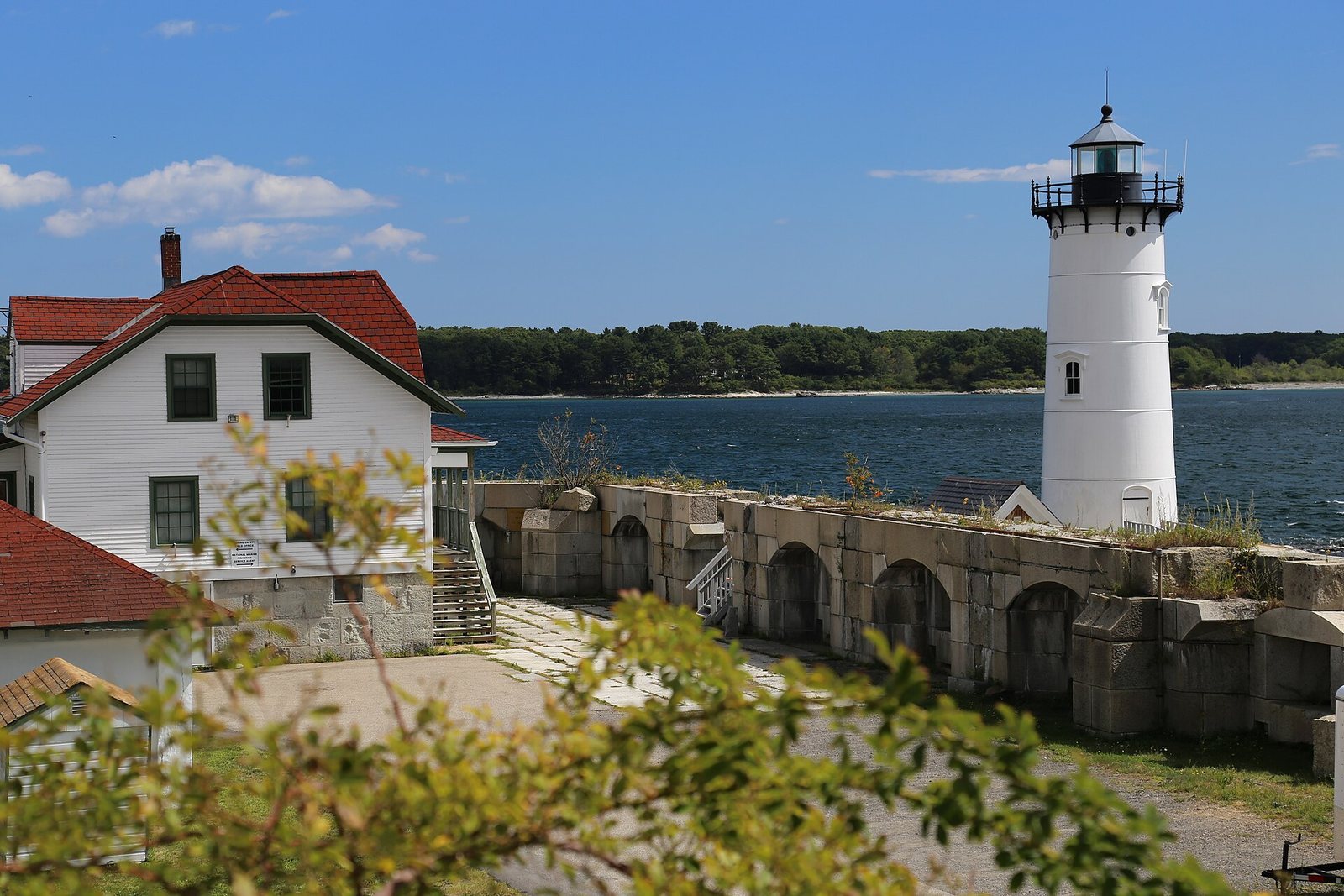
The fort and lighthouse cover about one hectare on Great Island, at the Piscataqua River’s mouth, facing the Atlantic and Portsmouth Harbor. The surviving site brings together early earthworks, later masonry fortifications, a lighthouse, and concrete coastal-defense works. Some Endicott-era concrete bunkers are covered or too deteriorated to enter, and a section of the old fort wall forms part of the shoreline protection.
Fortifications
Earthworks and masonry fort
The earliest defense was an earthwork armed with four guns. By 1692, a breastwork protected the earthwork, whose wall stood about one meter high. A wall roughly two meters high was built in 1705. At one stage, 19 guns stood on wooden platforms and fired through embrasures, openings in a fortification through which guns fire. The 1808 rebuilding created an irregular masonry enclosure with walls twice the height of their predecessors, powder magazines, and two brick barracks. The barracks were intended for 150 soldiers, and a 1811 report described them as able to house two companies. The fort was designed to mount as many as 36 heavy guns.
Walbach Tower
Walbach Tower, built in 1814, was a Martello tower, a compact coastal-defense tower designed to mount artillery. It carried one 32-pounder cannon. Its ruins stand on a hill above the later Battery Farnsworth.
Third System works
The planned Third System fort was to have three tiers of granite gun chambers and 149 guns. Construction left two shortened walls around portions of the largely intact older fort. These surviving ruins represent nineteenth-century fortifications.
Coastal-defense batteries and mine works
Battery Farnsworth
Battery Farnsworth was built partly below ground in a deep trench of reinforced concrete, beneath the hill where Walbach Tower stands. It held two 8-inch guns on disappearing carriages, mounts that lowered a gun behind cover after firing. Construction problems left the bunkers and magazines persistently damp, and they were considered unusable from 1905. The battery remains visible in the state park; a mine-observation station was later placed on top of it during World War II.
Battery Hackleman
Battery Hackleman was built beside Battery Farnsworth in 1904 with two 3-inch guns on pedestal mounts, fixed central bases that support guns. The guns were intended to defend the underwater minefield against minesweepers. During World War II, they were transferred to a battery of the same name at Fort H. G. Wright on Fisher’s Island, New York, and replaced by two guns from Battery Hays at Fort Stark. Battery Hackleman was later demolished.
Mine defenses
A mine casemate, a protected chamber for mine-defense equipment, was built beside Battery Farnsworth in 1920. During World War II, the fort stored mines, and a pier was used to load them onto boats. These installations formed part of the harbor’s layered coastal defenses.
Portsmouth Harbor Light
A 25-meter wooden lighthouse was built in 1803. It was replaced in 1878 by the present 15-meter cast-iron Portsmouth Harbor Light. Its Fourth Order Fresnel lens, stepped glass that concentrates light into a beam, remains a navigational aid; Fourth Order identifies the lens’s size class. The light was electrified in 1934 and automated in 1960.