Fort Laramie: A Fur-Trading Post and U.S. Army Post
Site at a Glance
- Country
- United States
- Primary era
- Modern
- Eras represented
- Modern
- Civilizations
- Unclassified
- Site type
- Military
- Remains
- Fort
On this page26 sections
History
Fort Laramie was a U.S. Army post at the confluence of the Laramie and North Platte rivers in Wyoming, United States. Established as a military post in 1849, it served travelers on westbound trails and became a military, communications, and diplomatic center on the northern Plains. The army remained there until 1890.
Fur-trading posts
The name Laramie ultimately comes from Jacques La Ramée, a French explorer and fur trapper who settled in the area in 1815. He disappeared after going trapping alone on the river around 1820 or 1821, and the circumstances of his death are uncertain. The river took his name, which was later applied to the fort and other places.
Before the army post, two private trading establishments operated in the area. William Sublette and Robert Campbell founded Fort William in 1834 to trade furs, particularly bison hides acquired from Indigenous peoples. Thomas Fitzpatrick took ownership in 1835, and the American Fur Company bought the post in 1836. As the fur trade declined during the 1840s, a larger establishment called Fort John had already been built to succeed it.
Pierre Cadet Chouteau, a fur trader and businessman who had acquired Fort William, built Fort John in 1841 at a cost of $10,000. Its trade increasingly served emigrants traveling west as demand for furs fell, while the post also faced competition from nearby traders.
Military post and westward migration
The military post’s foundation is dated to 16 June 1849. The U.S. government purchased Fort John for $4,000 on 26 June, and the army renamed it Fort Laramie. The army initially used the former trading post as a hospital, then for a corral and storage. The military post expanded to accommodate soldiers and assist people traveling west on the Oregon and California trails.
Fort Laramie supplied travelers with food and other necessities, mail, replacement draft animals, medical attention, and wagon repairs. At least 350,000 emigrants crossed the Missouri River heading west between 1841 and 1866, and many passed through the post on the way to Oregon, California, or the Salt Lake Valley. About 40,000 people bound for those destinations stopped at Fort Laramie in 1852.
Between 1856 and 1860, nearly 3,000 Mormon pioneers traveled through the post in handcart companies. Of ten expeditions, eight completed the journey. Two were hampered by late departures and shortages, then caught by an early winter storm; more than 200 people died near present-day Casper in October 1856. The handcart migration ended after 1860, when church leaders shifted to wagons and ox teams.
A public school opened at the post in 1852, the first in Wyoming. It served the children of soldiers and civilians, and an 1881 regulation placed responsibility for an effective school system on post commanders. After the army left, schooling for local settlers’ and ranchers’ children continued and later moved to the nearby town.
Diplomacy and conflict
Fort Laramie became a place for official dealings between the United States and Indigenous nations of the northern Plains. More than 10,000 people came for treaty negotiations in 1851, exceeding the post’s capacity, so the meeting moved to Horse Creek in western Nebraska. The agreement provided for settler travel and military posts while setting out U.S. promises of protection and compensation and territorial guarantees for Indigenous peoples. The fort thereafter served informally as a diplomatic center for the region.
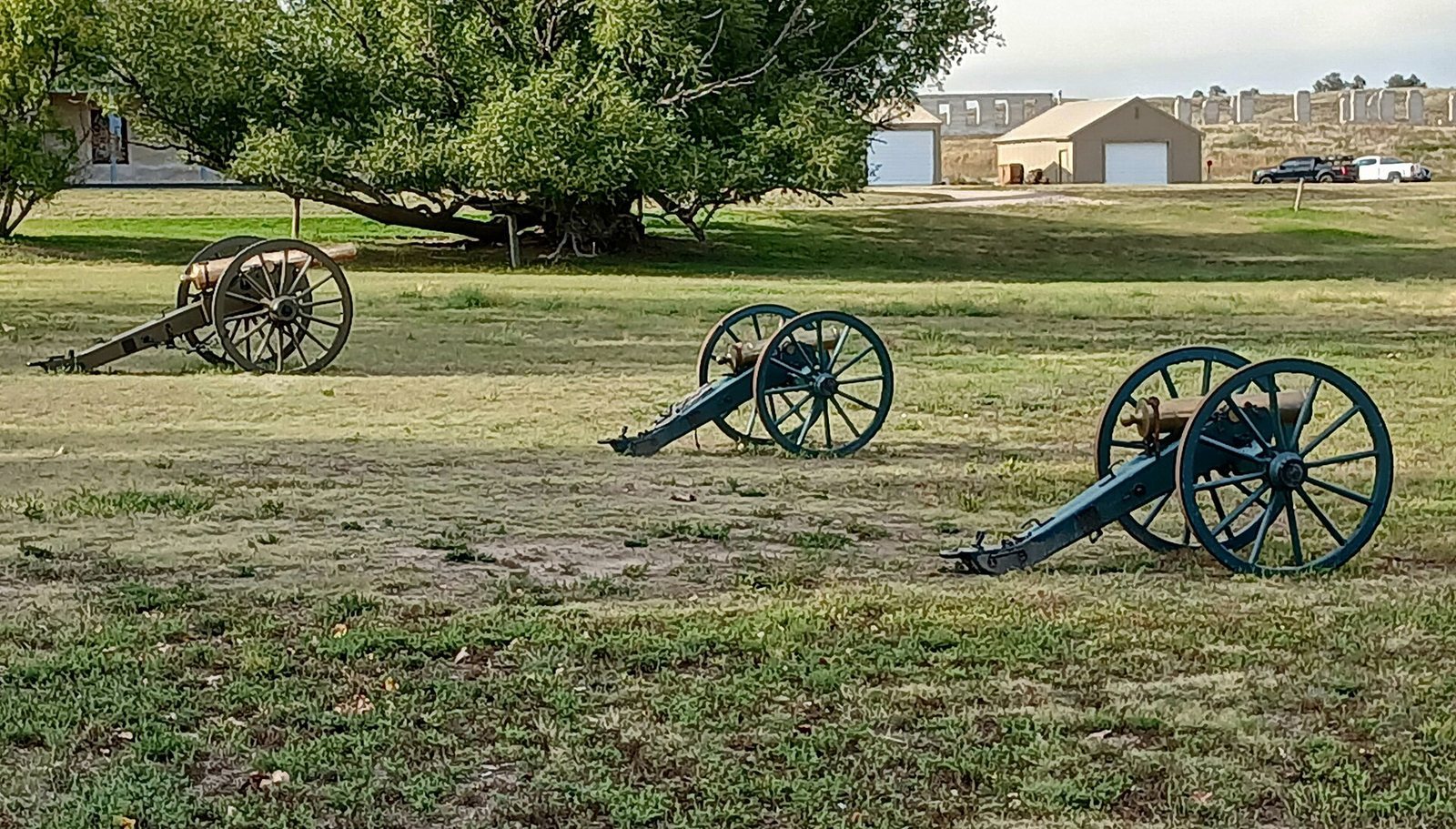
On 17 August 1854, an encounter near the post later known as the Grattan Massacre began when Lieutenant John L. Grattan led 29 soldiers, an interpreter, and two howitzers to a large Indigenous village. Their aims were to recover a cow taken from Mormon emigrants and arrest the alleged thief. The soldiers fired artillery, killing, among others, the Minneconjou leader Mahto Wayuhe. Sichangu followers of Spotted Tail and Oglala followers of Red Cloud then overwhelmed Grattan’s detachment. The incident led to further violence in the region, although Fort Laramie itself was not attacked.
Tensions grew after the Bozeman Trail opened in June 1865 across lands protected by the 1851 treaty, amid the westward advance of the transcontinental railroad. From 4 to 6 February 1865, Cheyenne and Lakota warriors fought the Battle of Mud Springs about 169 kilometres east of Fort Laramie. A force of 172 soldiers left the post to aid troops there, leaving its garrison dangerously depleted; the army consequently ordered temporary defenses at Fort Laramie. The post later served as a rear base during Red Cloud’s War, the conflict of 1866–1868 associated with U.S. expansion into treaty-protected lands.
Fort Laramie was an important supply and military center during Red Cloud’s War and the Great Sioux War of 1876. On Christmas Eve 1866, messenger John “Portuguese” Phillips arrived after riding 236 miles through a snowstorm. He brought news of the Fetterman battle and an urgent request for reinforcements at Fort Phil Kearny.
Peace councils met at Fort Laramie again from 1866 to 1868. The 1868 Fort Laramie treaty ended Red Cloud’s War, recognized Sioux claims to the Powder River region and the Black Hills, and committed the U.S. government to abandon three forts on the Bozeman Trail and close the trail to wagon traffic. Other agreements concluded later that year with Cheyenne, Arapaho, Crow, Lakota, and Dakota parties established the Great Plains reservation system. These treaties shaped relations between tribal nations and the federal government, and their conclusion ended the post’s role as a council meeting place. The agreements were later violated after gold was found in the Black Hills in 1874, contributing to renewed conflict.
Communications and life at the post
Fort Laramie also connected travelers and the army through postal and communications services. A post office opened in 1850, and the post served as a stagecoach relay. It was a Pony Express stop from 3 April 1860 to 24 October 1861. The transcontinental telegraph reached Fort Laramie from the east on 5 August 1861. Soldiers guarded and repaired the line and operated relay stations between Julesburg to the east and South Pass to the west. In May 1869, a multiwire system associated with the Union Pacific and Central Pacific railroads replaced the line.
The garrison numbered about 700 men. Their work included drills, guard duty, inspections, construction and repairs, telegraph operations, hauling water, and cutting and storing ice. Military discipline covered offences from absence without leave to loss of government property, while alcohol frequently contributed to disciplinary problems. Before the Civil War, punishments could include whipping, branding, or painful restraints.
Army laundresses washed soldiers’ clothing and could also work in officers’ households as cooks, domestic workers, or midwives. They lived and worked in an unhealthy area known as Soap Suds Row, and their numbers at the post began to decline in the late 1870s. Three military hospitals served Fort Laramie between 1849 and 1890. The later hospital, built in 1873, also treated civilians and was the only hospital within about 160 kilometres. By the late 1880s, a telephone connected it with the surgeon’s residence.
The quartermaster department, responsible for supplies, transport, and facilities, managed construction and maintenance as well as the movement of goods. Its workshops and stores supported Fort Laramie’s military and logistical work during the Plains Indian wars. In 1875, its 52 civilian employees included teamsters, a telegrapher, an engineer, clerks, interpreters, blacksmiths, and saddlers.
Limited supplies of fresh vegetables contributed to illness. In the winter of 1849, scurvy affected one-fifth of the garrison and left those soldiers unable to fight. The army encouraged gardening, and irrigation developed from the 1850s with the help of Hispanic workers. A waterwheel was installed in 1869, followed by a diversion dam and ditch system in the 1880s. By 1889, nine acres were under cultivation.
Closure and preservation
The transcontinental railroad’s completion in 1869 reduced emigrant traffic and diminished the post’s civilian and military importance. The army began withdrawing troops in 1889, formally decommissioned Fort Laramie on 2 March 1890, and removed the last troops on 20 April. The complex was auctioned that year. Settlers reused much of its building material, and the stables were dismantled.
Wyoming acquired 214 hectares at Fort Laramie in 1937, and restoration began the following year. President Franklin D. Roosevelt designated the site a National Historic Site in 1938. It was listed in the National Register of Historic Places as a National Historic Landmark in 1966 and is managed by the National Park Service.
Remains
Fort Laramie stands where the Laramie and North Platte rivers meet. Its buildings were arranged around a large parade ground. The historic site includes 22 original structures, 11 of them fully restored; other buildings have also been restored or reconstructed and furnished with period objects. The remains include earlier trading posts, military buildings, defensive works, and irrigation features.
The trading posts
Fort William
Fort William was a small rectangular timber fort, about 30 by 24 metres, enclosed by a palisade of squared cottonwood logs roughly 4.5 metres high. Log-built fortified chambers stood at two corners, with a third armed with a cannon above the main gate. Cabins, workshops, and warehouses lined the inside of the enclosure. Its exact location is uncertain, although it was near the later Fort Laramie and may have occupied the same ground. Archaeological searches have sought its remains.
Fort John
Fort John was a rectangular trading post about 51 by 37 metres, built of adobe, or sun-dried earthen brick. Its roughly 4.5-metre-high walls had projecting corner defenses and large double gates. Residences, blacksmith workshops, and warehouses stood inside, along with space where Indigenous traders exchanged bison hides for manufactured goods. The former grounds lie on the south side of the later parade ground. The buildings used adobe and timber; the complex was abandoned by 1858 and dismantled in 1862.
Buildings around the parade ground
Old Bedlam
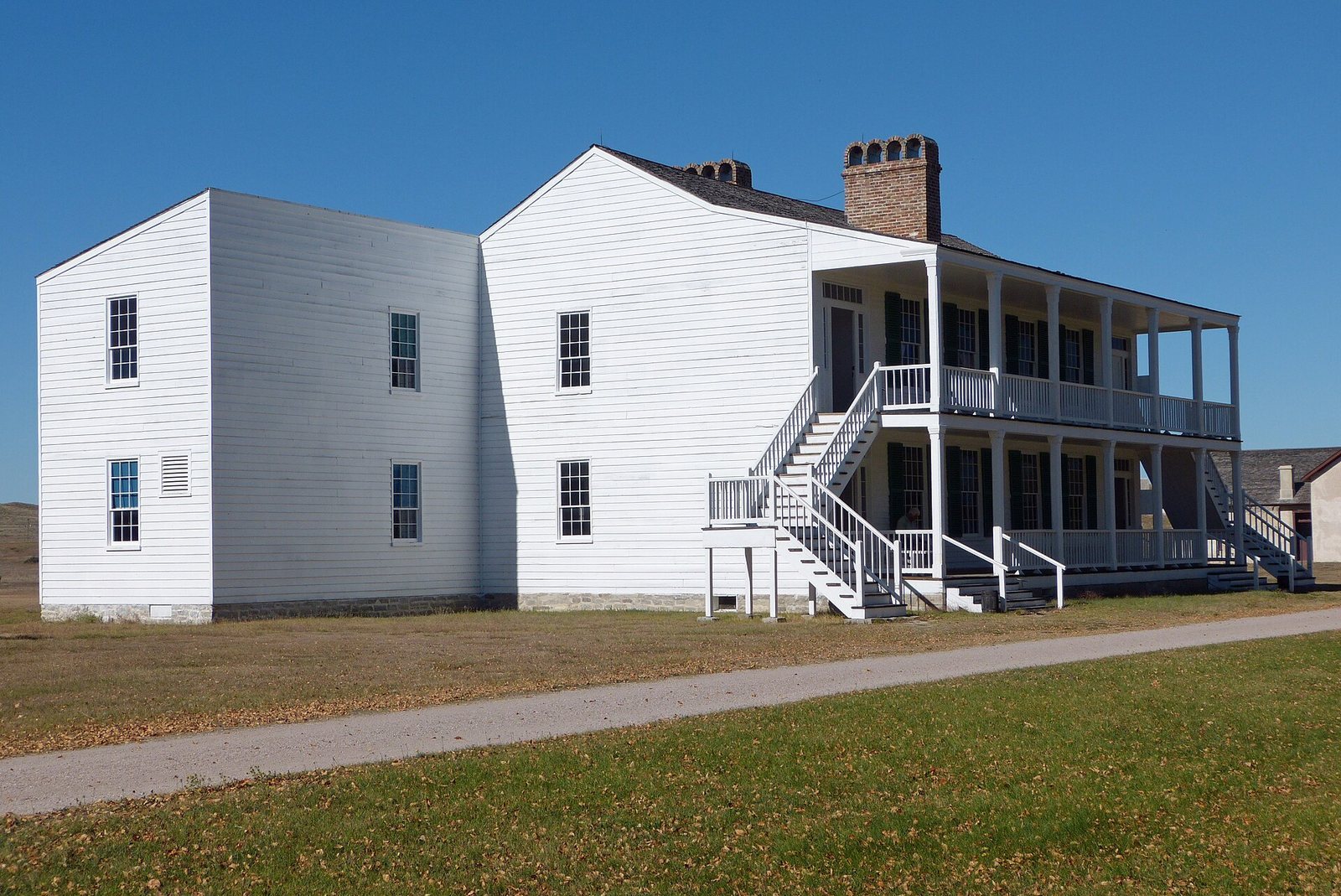
Built in 1849 as quarters for unmarried officers, Old Bedlam is the oldest surviving building in Wyoming.
Officers’ residences
The commander’s residence, built in 1870, was later divided into two homes for senior officers and their families. An officers’ building dating to 1862 had first stored weapons, ammunition, and other supplies before being adapted as quarters. Constructed from adobe, timber, and cement, it formed part of a larger housing response in 1881, when an additional complex was built because existing accommodation was inadequate. That complex comprised a large adobe-and-cement building, two duplexes, and the commander’s house.
Barracks
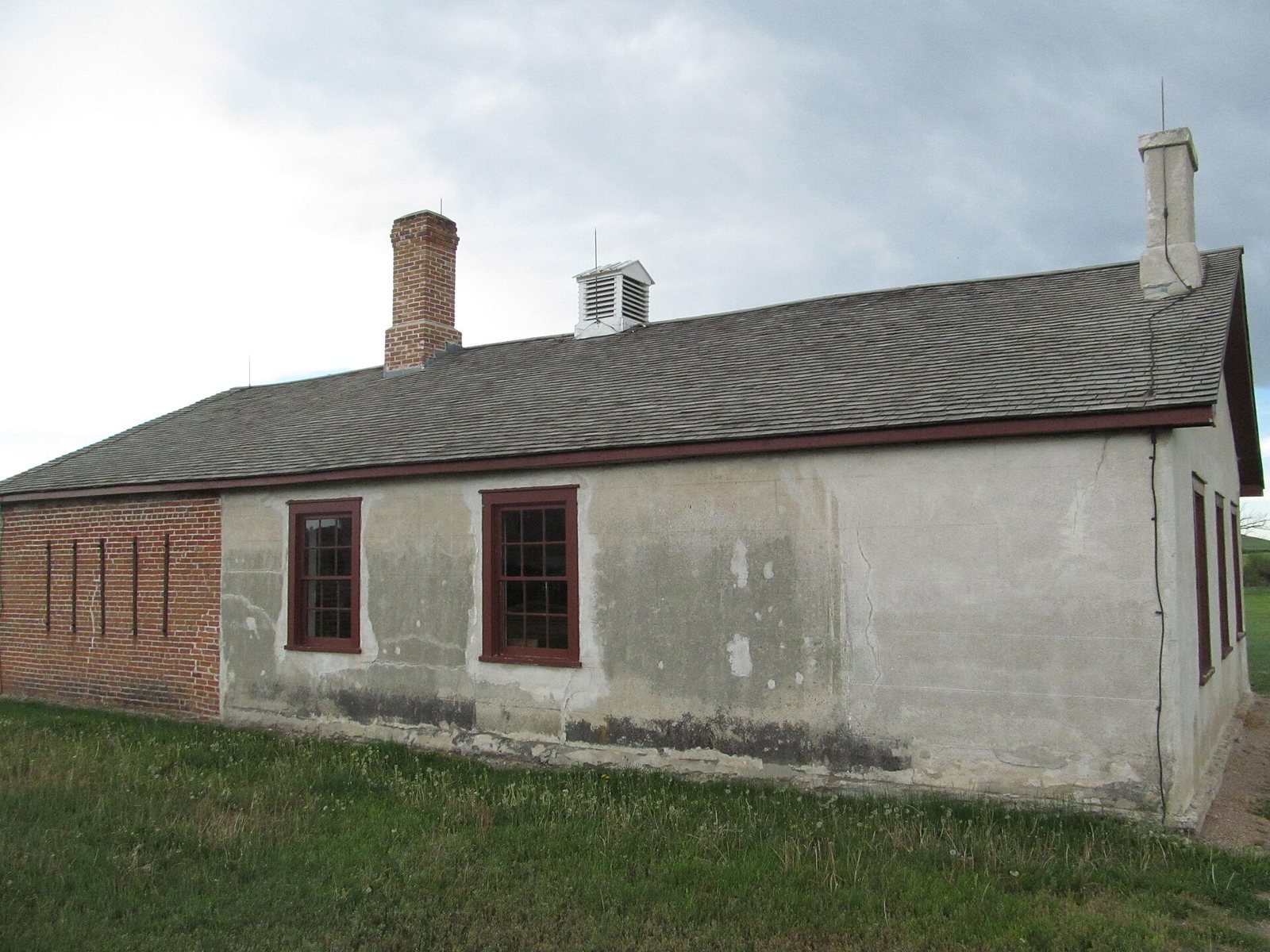
The cavalry barracks, built in 1874, were the post’s largest buildings. Soldiers slept in two large dormitories on the second floor. After the army sold the building, it was adapted for housing, shops, and a tavern with a dance hall; it has since been restored and furnished. The infantry barracks built in 1867 were a single-storey timber-frame building intended for three companies, each with its own kitchen and dining room. Of separate infantry barracks built in 1866 for two companies, only the southeastern foundations remain. Their kitchens and dining room stood behind them.
Guardhouse and prison
The guardhouse built in 1866 had a large ground-floor room for prisoners and two isolation cells. Guards and their superiors lived upstairs. A new prison followed in 1876 because the older facility was overcrowded and unhygienic. Designed to hold 40 prisoners, it also improved conditions for the guards.
Administration building
Ruins mark the site of the brick administration building constructed in 1885. It housed the post court and library. The rear section accommodated theatrical and religious events and served as a schoolroom for the children of soldiers and officers.
Trade, supply, and medical buildings
Post-trader’s store
A civilian built the post-trader’s store in 1849 with the army’s permission. The store sold tools, food, and whiskey to soldiers, Indigenous people, gold seekers, and emigrants; it has been restored to represent its 1876 appearance. A stone extension on the north side, added in 1852 as the manager’s residence, became a drinking room in 1883. A separate employee house was built in 1886 during the Ward-Bullock partnership, and William G. Bullock lived there for a time.
Food store and bakery
The food store, built in 1884, distributed provisions for the military. Afterward it was used privately as a cold store and partly as a barn, and it has since been restored. The new bakery, built in 1883, contained brick ovens that produced about 700 loaves weighing 750 grams each per day.
Post office and workshops
The post office was built in 1850 beside the sutler’s store. A sutler was a civilian merchant serving an army post. Other service buildings included a blacksmith’s shop, farrier’s shop, shoemaking shop, bakery, and administrative buildings.
Hospital and medical quarters
The third hospital was built in 1873 on the site of an earlier post cemetery. It contained 12 beds, a treatment room, kitchen, dining room, dispensary, bathroom, toilets, and offices. Six graves were moved before construction, while dozens remained around the building. A smooth white interior finish aided cleaning and disinfection, and sunny verandas provided space for convalescing patients. The hospital steward’s quarters stood behind it. A separate medical building dating to 1875 was a duplex occupied by the fort doctor and his family; its southern half has been renovated and furnished to represent about 1880.
Public latrine
A ruin marks the public latrine built in 1886 for enlisted men. Its wastewater drained directly into the nearby Laramie River.
Defenses, waterworks, and memorials
Rifle trench and redoubt
A long, shallow depression marks the line of a rifle trench built in 1865. Excavated earth formed a protective bank reinforced along its top with grain sacks, and a firing step ran inside the trench. Archaeologists consider it possible that wooden boards lined some or all of it. The army also ordered three artillery positions connected by rifle trenches. An adobe redoubt, a small enclosed defensive work, was built the following year to strengthen the temporary defenses and to provide an enclosure and lodging for wagon drivers. Its walls stood about 2.4 metres high, with a hexagonal blockhouse at each of two opposite corners. The trenches later fell into disrepair.
Irrigation works
The irrigation system included a waterwheel on the Laramie River installed in 1869 and a diversion dam built in the 1880s. Ditches carried water through the gardens and parade ground, and portions of the ditch system remain in use.
Cemetery and commemorative markers
The site includes a military cemetery, a grave identified as that of the Unknown Soldier, and a memorial with a plaque dated 1913. Commemorative plaques also mark the Pony Express, the transcontinental telegraph, and the Mormon Pioneer Trail.