Jinguitou Fortress: A Coastal Artillery Fort in Penghu, Taiwan
Site at a Glance
- Country
- Taiwan
- Primary era
- Modern
- Eras represented
- Modern
- Civilizations
- Unclassified
- Site type
- Military
- Remains
- Fort
On this page8 sections
History
Jinguitou Fortress is a coastal artillery fortification on Penghu, an archipelago off Taiwan’s western coast. It developed from an earlier artillery work into a key part of Penghu’s defenses, with the surviving complex shaped mainly by its rebuilding in 1887.
Early fortifications
An artillery work stood at the site during the Kingdom of Tungning, a Zheng family regime that ruled Taiwan in the late seventeenth century. In 1717, Penghu’s new city was rebuilt in the fortress area. The following year, the Qing Ministry of War approved rebuilding one of twelve fortifications inherited from the Ming, the preceding Chinese dynasty, at the request of the Fujian governor-general. The Qing dynasty ruled Taiwan during the fortress’s eighteenth- and nineteenth-century phases.
Qing coastal defenses
Vice Brigadier General Wu Qixun repaired the fort in 1864 and gave it the name Jinguitou Fortress. During the Sino-French War, a conflict between France and Qing China in the 1880s, a French warship hit its ammunition magazine and disabled the fort. At that time, Jinguitou and Xincheng had the greatest firepower among Penghu’s forts.
After Taiwan became a province, governor Liu Mingchuan and Yang Changjun, governor-general of Fujian and Zhejiang, inspected Penghu and urged stronger defenses. They described the island as a vulnerable gateway between Fujian and Taiwan. Liu repeatedly petitioned for improvements, and the Qing court appointed garrison commander Wu Hongluo to oversee the work. In 1887, four modern forts were built: Jinguitou, Xiyu West, Xiyu East, and Gongbei. Jinguitou received three Armstrong guns, artillery pieces designed by British engineer William Armstrong, measuring 7, 10, and 12 inches.
Japanese occupation
On 23 March 1895, during Japan’s invasion of Penghu, Japanese forces landed on the island’s eastern coast, avoiding the guns at Jinguitou and the Xiyu forts, and captured Penghu city. Jinguitou then fell. Around 2 p.m. on 25 March, Japanese forces repaired the fortress and began firing on Xiyu East Fort. At about 4 p.m., Qing forces removed important parts from Xiyu East’s guns and withdrew from Penghu, leaving Japanese forces in control.
Japanese authorities rebuilt Jinguitou between 20 May 1902 and 15 September 1904, renaming it the Southern Sky Battery. The Japanese army also used the fort for military maneuvers.
Postwar military use and preservation
After the Second World War, the Republic of China Army used the site as Tian Nan Camp of the Penghu Defense Command, including as a base for its communications battalion. Military use continued until the Ministry of National Defense released the land and transferred it to Penghu County Government. Taiwan designated the fortress a National Monument on 21 November 2001.
Remains
Fortification layout and buildings
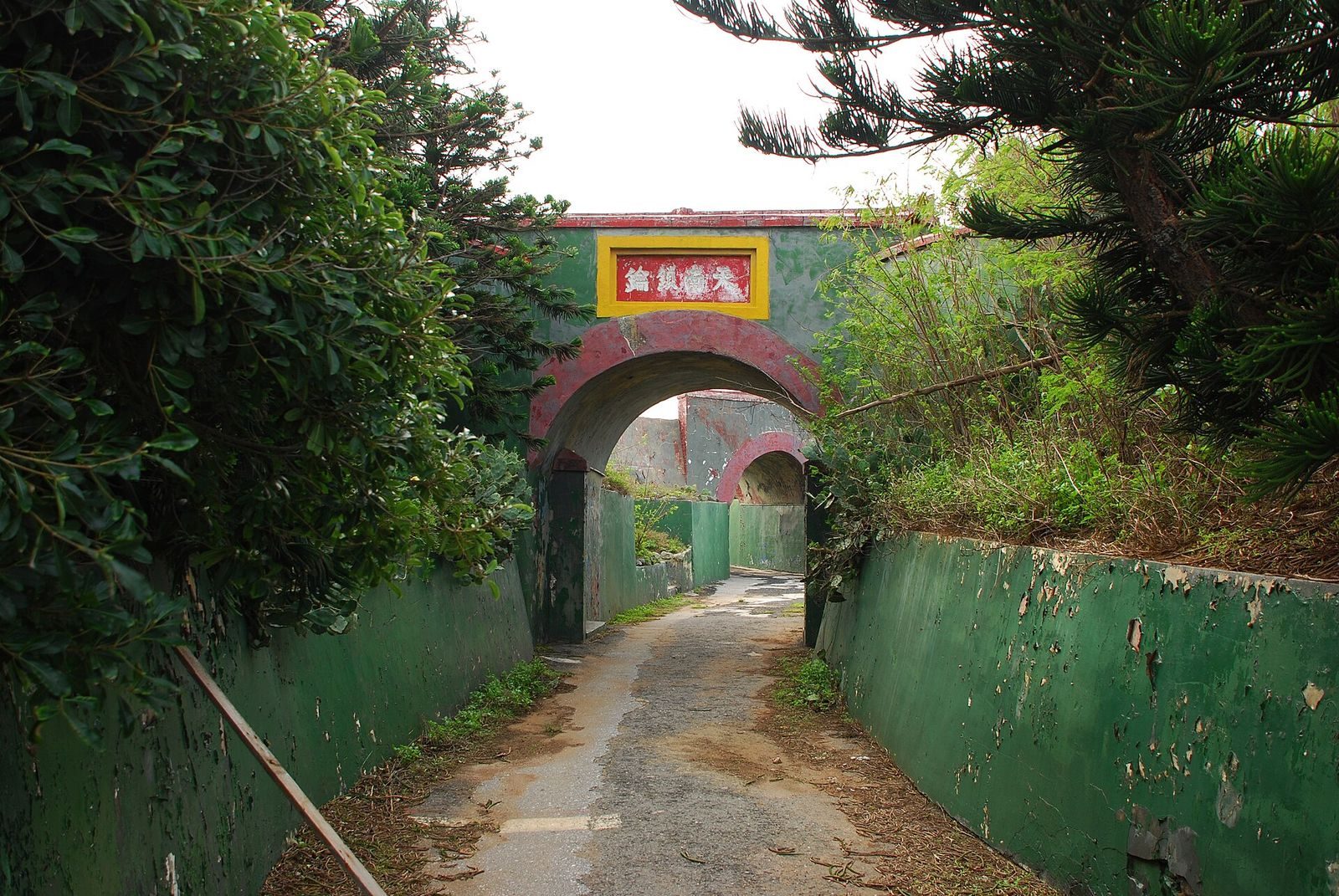
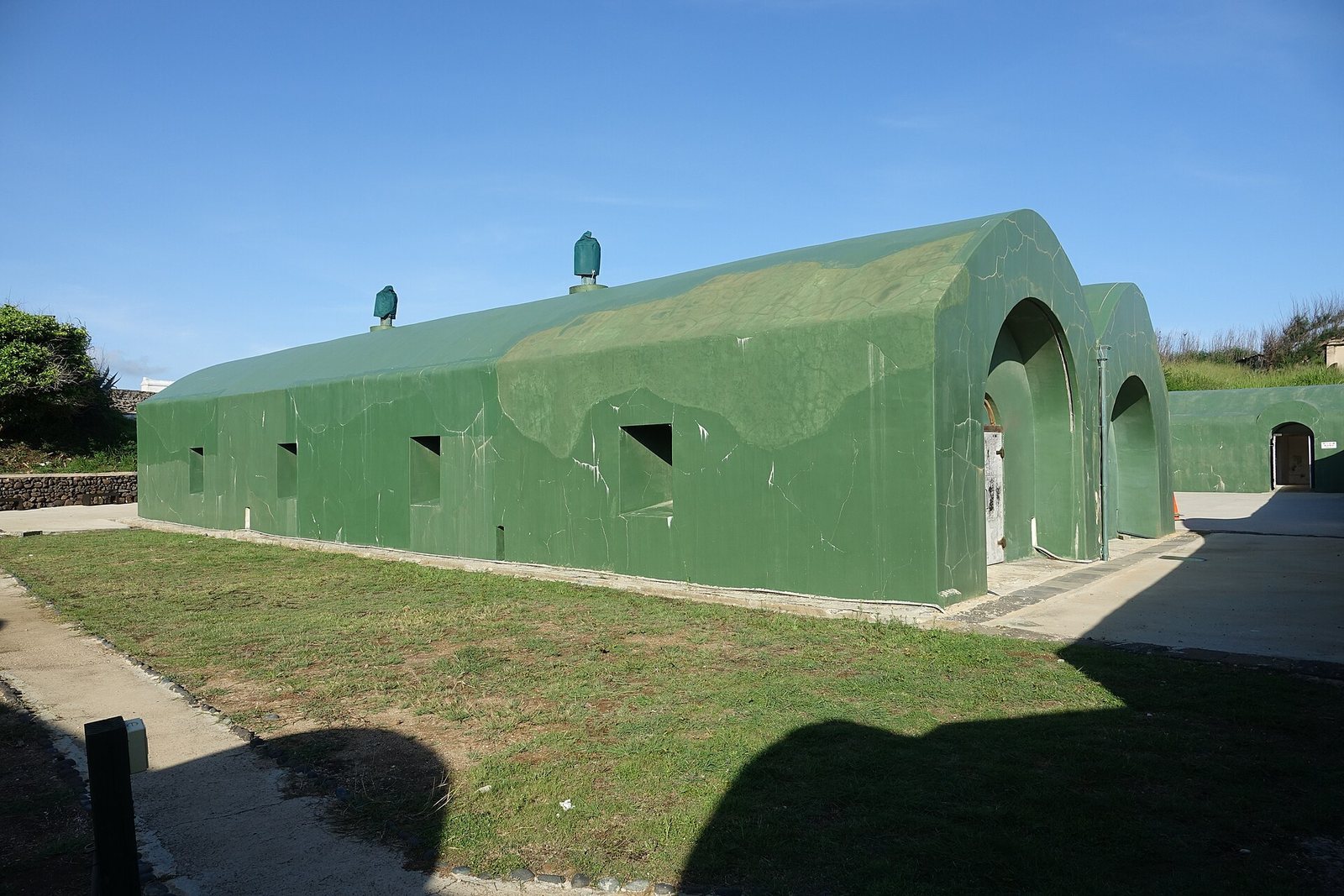
The surviving fortification is mainly the 1887 complex, with a rectangular plan formed by inner and outer walls and two arched entrances. Its buildings use brick and stone or reinforced concrete. The site includes gun positions, tunnels, an administrative building, barracks with vaulted ceilings, and walkways along the defensive walls. The arrangement served combat, training, and residential needs, with barrack rooms divided into differently sized spaces. A large barracks, ammunition depots, and three offices stand near the fortress.
Gun positions and entrances
The gun-platform foundation, circular platform structure and base, and inner and outer gates remain in reasonably good condition. An inscription on a gate’s horizontal lintel, the beam above the entrance, means “Key to the Southern Sky” and was written by Wu Hongluo. Two Armstrong guns remain at the fort, one measuring 10 inches and the other 12 inches. In 2013, Penghu County’s Cultural Affairs Bureau installed a U.S.-made M1 40 mm antiaircraft gun, a weapon designed to engage aircraft. The military had previously used a gun of this type at the site before removing it when the equipment was retired; the replacement was transferred from the Army Ordnance Maintenance and Development Center.