Ixtlán del Río (Los Toriles): A Pre-Columbian Archaeological Site in Nayarit
Site at a Glance
- Popularity
- Medium
- Country
- Mexico
- Primary era
- Medieval
- Eras represented
- Classical, Medieval, Early Modern
- Civilizations
- Unclassified
- Site type
- City
On this page21 sections
History
Early occupation
Ixtlán del Río, also known as Los Toriles, is a pre-Columbian archaeological site in Nayarit, Mexico, associated with the Aztatlán tradition and Nahua peoples. The site was probably occupied from about 300 BCE, before later growth within the Aztatlán cultural sphere.
The early Ixtlán phase, dated to about 300 BCE to 300 CE, is linked to shaft tombs, burials reached through a vertical passage that could lead to one or more chambers. This burial tradition faded around 500 to 600 CE. A later way of life emerged around 750 to 900 CE, during the development of the Aztatlán tradition, a cultural tradition of western Mexico broadly dated from about 700 BCE to 1520 CE.
The Aztatlán city and regional center
The mid-Ixtlán period, about 750 to 1110 CE, is identified as the city’s peak. The late Ixtlán period followed, from about 1110 to 1525 CE, while another broad dating places the city’s flourishing between about 700 and 1200 CE. Its civic foundation is also placed in the twelfth century, when Nahuatlaca, or Nahua, groups traveling toward the Valley of Mexico are said to have established the city.
Ixtlán formed part of the Ahuacatlán lordship, a territory governed by a local authority. This political association is linked to building activity and the manufacture and exchange of obsidian goods. Ixtlán became a regional center for production and commerce, with influence across areas that are now Ixtlán del Río, Ahuacatlán, Jala, and Santa María del Oro. Its sphere included Cacalután, Tepuzhuacán, Mexpan, Zoatlán, Xala, Jomulco, Tequepexpan, Camotlán, Tetitlán, Acuitapilco, and Zapotán.
The Aztatlán tradition shared cultural traits with the Toltecs, a pre-Columbian civilization centered at Tula, and was influenced by the central highlands. Corinca is identified as its final governor. The people associated with Ixtlán are linked to the ancestors of the Cora and Wixáritari, also known as Huichol. The name Ixtlán has been interpreted as meaning either ‘place where obsidian is abundant’ or a place dedicated to Ehécatl, a wind deity understood in Nahua religion as a form or aspect of Quetzalcoatl. The city is also described as dedicated to Ehécatl.
Spanish arrival and rediscovery
At the time of Spanish arrival, communities in the region spoke languages belonging to the Uto-Aztecan family and organized their political life through lordships governed by local lords. Ruling groups may have held noble status.
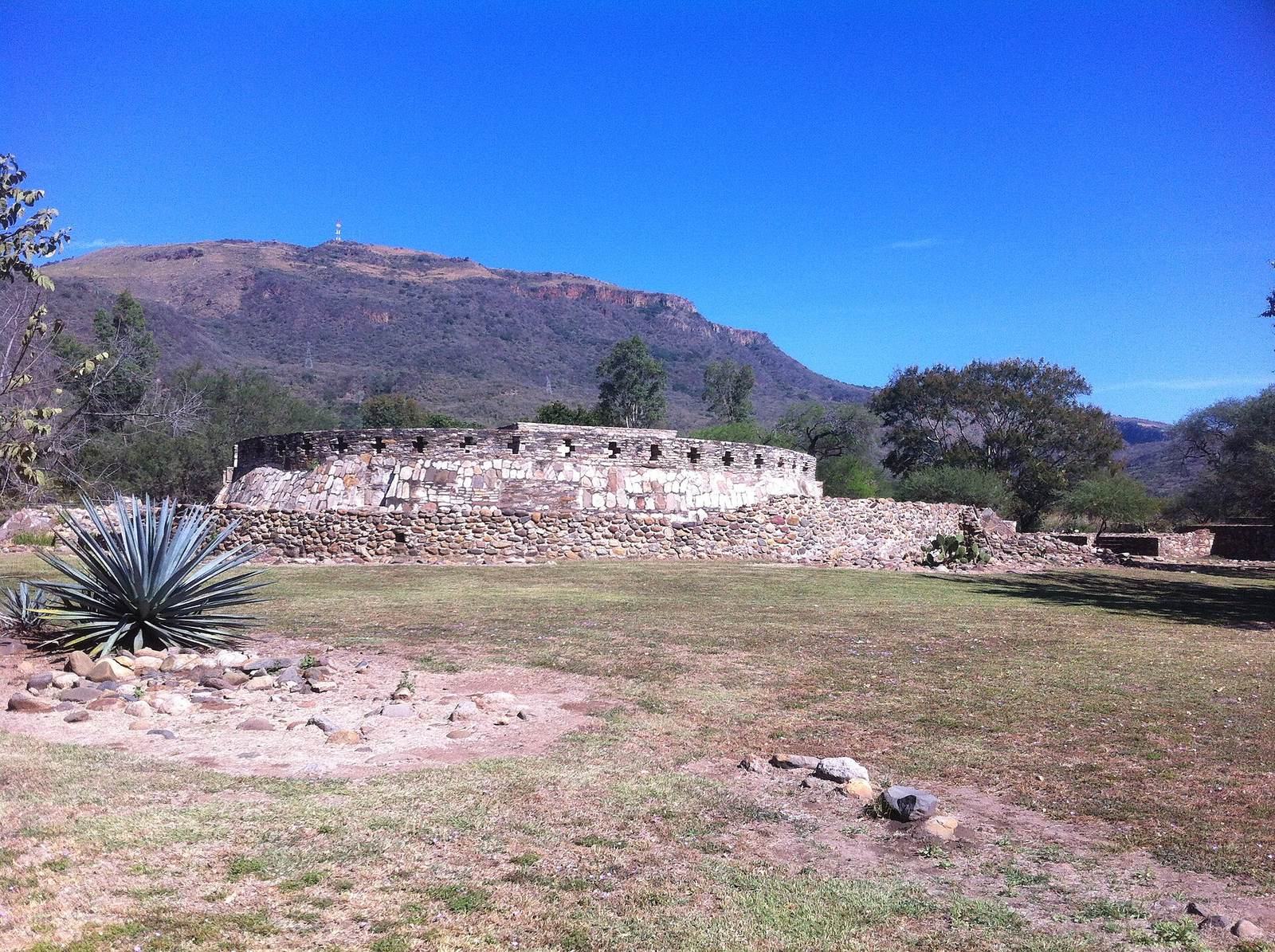
Professor José Corona Núñez discovered the site’s circular monument in 1948. Later archaeological work explored and restored some of the structures, bringing parts of the ancient complex back into view.
Remains
Urban layout and construction
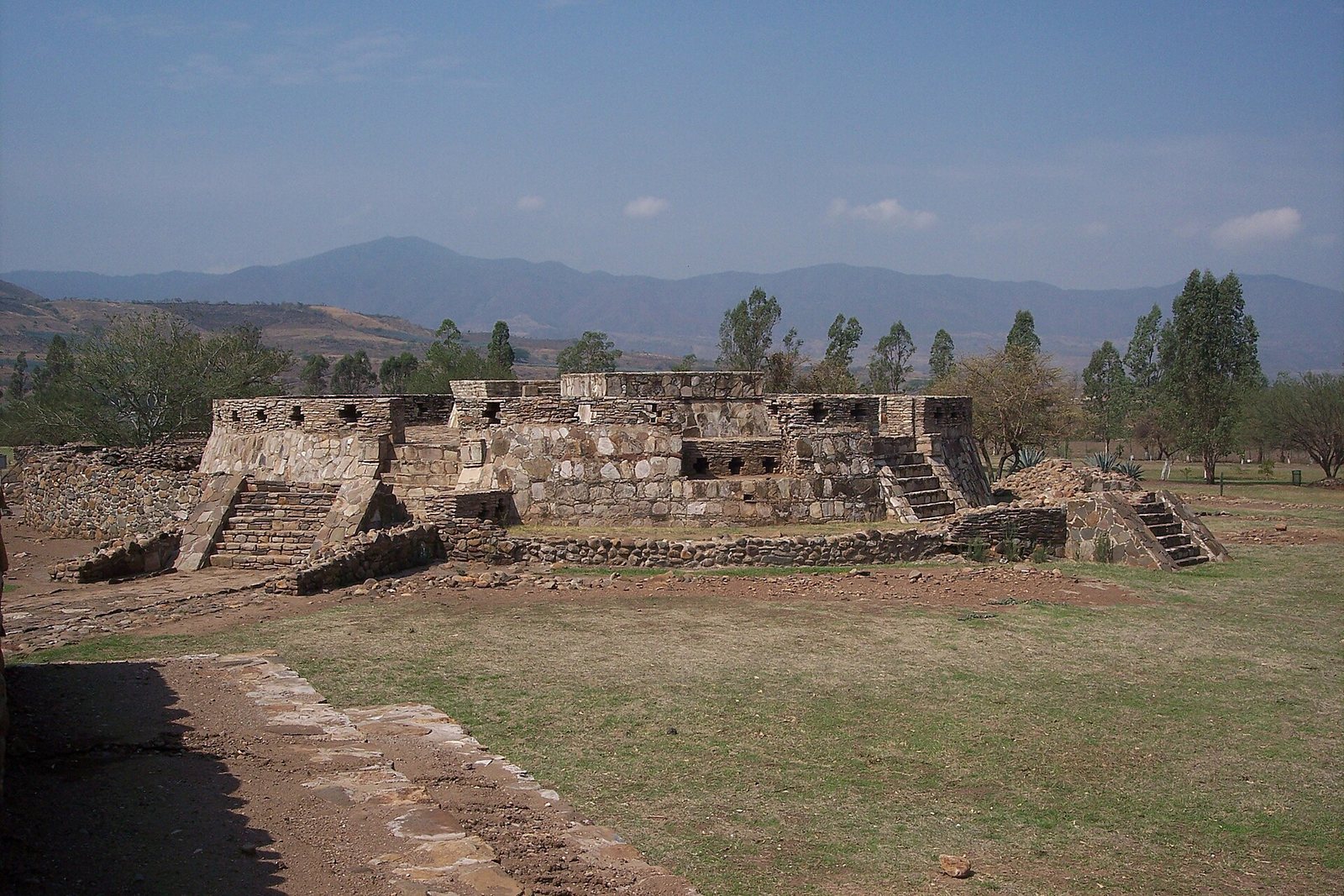
The archaeological zone covers more than 80 hectares and includes an organized landscape of terraces, open spaces, plazas, altars, walkways, drains, causeways, neighborhoods, palaces, temples, and residences. Terraces on the slopes supported buildings, places of worship, homes, agricultural land, and workshops where obsidian was worked. More than 85 mounds and structures have been identified. Other named buildings include the Reliefs Palace, Columns Palace, Four Column Palace complex, and Square Palace.
Builders used rounded stones bonded with clay and stone slabs for temples and places of worship. Some stones carry carved spirals or serpent designs. Other recorded features include adobe pilasters, flat supports attached to walls, platforms, stairways, walkways, retaining walls, and carved stone reliefs.
Major ritual monuments
The circular temple
The circular monument, also called the Quetzalcoatl or Ehécatl temple, measures about 24 metres across and 4 metres high. Five stairways are spaced around its perimeter. A low parapet crowns the structure, pierced by small cross-shaped openings, and some stairways retain cross-shaped handrails. Its cylindrical body is described as originally having vertical sides, while sloping walls are also part of its description.
A road paved with stone slabs runs from another temple to the circular monument. Its open upper courtyard contains two raised bases, one to the north and one to the south, with stairways directed inward. The northern base has a smooth upright panel, while the southern base has a sloping cornice. The bases are associated with small altars, columned entrances, roofs, and carved stone ornaments, including arrowhead shapes and discs marked with two circles. These architectural features have been interpreted as evidence of a connection with Toltec design.
Plaza altar and surrounding buildings
One plaza has an altar with four small stairways, flanked by buildings that appear to contain small rectangular rooms. The buildings stand on platforms with adobe pilasters and have associated walkways and stairs.
Excavated architectural sections
Section A
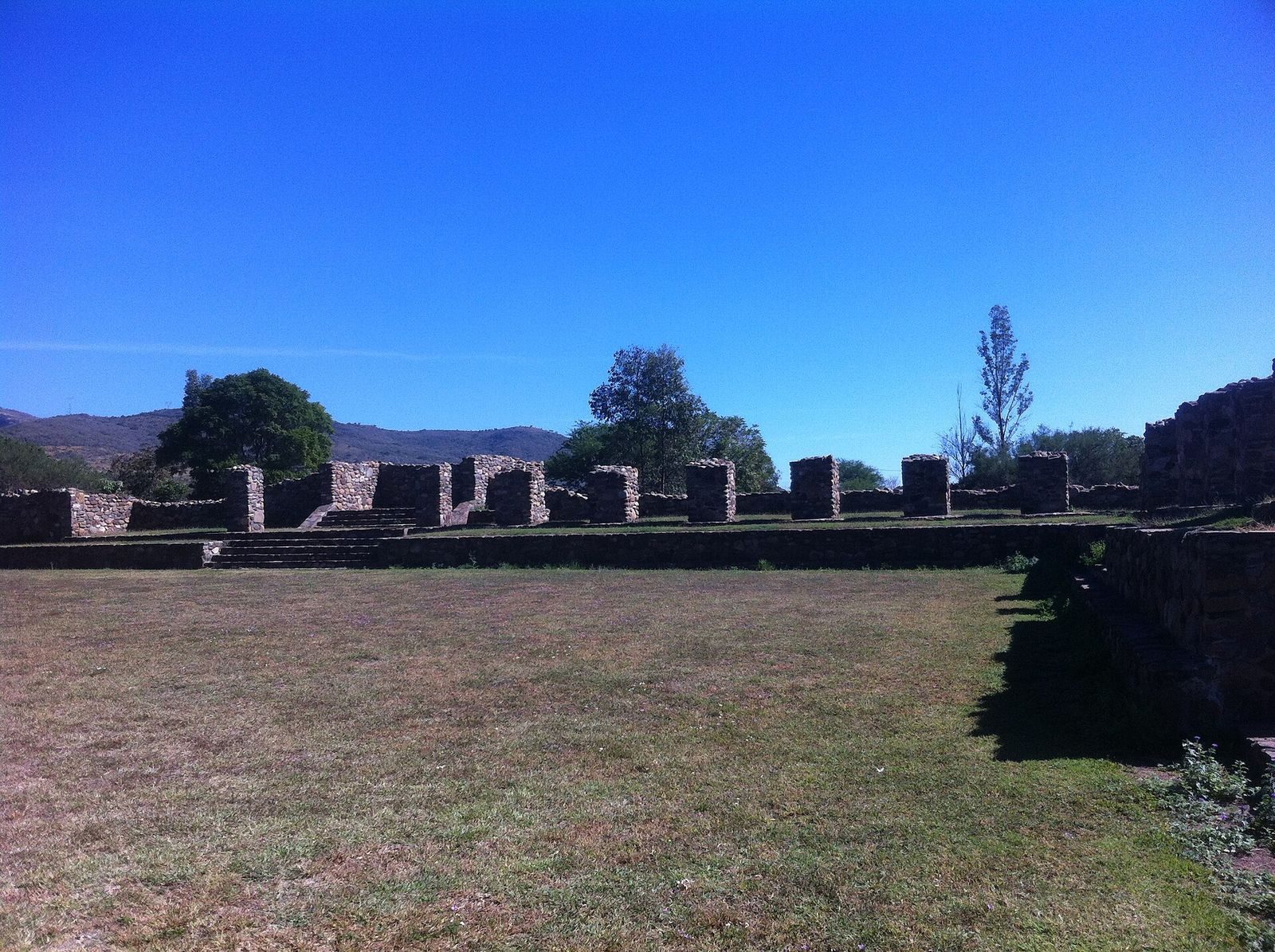
Section A contains four structures from the earliest explorations. Two restored rectangular buildings have front columns that divide the spaces between rooms. They belong to a plaza with a pyramidal foundation and a central altar. Mounds to the north and east form part of the surrounding complex.
Section B
Section B has two plazas, each bordered by rectangular monuments and building foundations, including small pyramid-shaped altars. Each plaza contains nine monuments. The explored and restored structures vary in height and size to suit the terrain and the layout of their plaza, and their stairways face inward toward the open space.
The buildings combine three enclosed spaces with an open front area where pillars supported a roof. Dirt floors preserve evidence of pre-Hispanic use. Retaining walls and carved reliefs bear religious symbols and animal designs.
Section C
At the entrance to the archaeological zone, Section C includes three explored and restored structures within a larger complex of plazas and buildings centered on an altar. One prominent, single-storey building has two rectangular sections and stairs facing the plaza. Large columns supported the roofs of two halls. The eastern hall has a room and a stairway incorporated into the wall behind the building.
The central altar in Plaza C is a two-tiered pyramid with stairs on all four sides. Its principal staircase faces west, and a side wall terminates at the top in a dice-shaped feature. The altar stands between two mounds. Its retaining walls were coated with stucco, a fine plaster finish.
Burials and carved stone
Shaft tombs
Five major concentrations of shaft tombs have been identified. Their vertical wells had circular or square openings, measured about 0.80 to 1 metre across, and ranged from 1.5 to 16 metres deep. A well could lead to one or two chambers and contain offerings. The tombs have been interpreted as representing the maternal womb. Other burials took the form of shallow graves in the earth.
Finds associated with the tombs include human bones, household pottery such as cooking griddles and pitchers, and sculptures of people and animals.
Petroglyphs
Five areas contain petroglyphs. The best-known groups are at El Terrero, Sayulapa, and El Veladero. Their carved and scratched designs include abstract forms, among them spirals with radiating lines.
Pottery and modeled figures
Pottery
Regional pottery is associated with the Chimisco, Ixtlán, and San Sebastián styles. Red, orange, yellow, and beige colors appear alongside negative decoration, a technique that forms patterns through contrast between treated and untreated surfaces. Common subjects include warriors, musicians, women, sick people, and couples.
Later household wares include smooth red ceramics, bowls, and tripod grinding mortars decorated in white over red. Other vessels have rounded bodies, upright sides, tall necks, and three bell-shaped supports. Their designs include flowers, stylized butterflies, deer and tiger heads, and white-on-red diamonds and segments.
Ixtlán-style sculptures
Sculptures in the Ixtlán style range from about 5 to 80 centimetres high. Some small figures, around 30 to 40 centimetres tall, wear earrings and have pierced noses fitted with one or more rings. Larger human figures, about 20 to 80 centimetres high, may stand or sit and have varied clothing and facial painting, ranging from naturalistic to stylized.
Women are shown carrying vessels or children, while men hold balls or instruments; some figures represent soldiers with shields. Figures of both sexes wear jewelry, ornaments through their pierced earlobes, and collars made from cut shells.
Shaft-tomb figures and scenes
Figures associated with shaft tombs date to the Late Preclassic period, about 400 BCE to 200 CE, and the Classic period, about 200 to 650 CE. These successive periods are broad phases used in Mesoamerican archaeology. The figures were formed from reddish clay, dried, and fired in open fires, then painted in black, red, orange, yellow, and beige. Their subjects include funeral processions, villages, people resting on beds, pole-flying rituals, and ball games.
Procession models show groups carrying a dead person toward a house, sometimes accompanied by musicians and food plates; some also depict cheek piercing. In pole-flying scenes, a person dressed as a bird appears in a flying pose on a pole, while houses and onlookers occupy the area below. Ball-game models resemble an I-shaped court, with houses at either end and spectators. Other figures show circular dances and people playing drums, conch shells, or flutes. Some models link figures with an instrument passing through their pierced cheeks. People shown lying on beds are tied to them and may represent women who died in childbirth or were recovering from illness.
House and village models
Five types of house model, about 18 centimetres high and 20 centimetres wide, have been classified. Their roofs slope to raised triangular corners. One type shows a roof and people without walls; another has a large enclosed room; a third has partly slanted walls; a fourth has two storeys, rooms, and stairs; and a fifth resembles the two-storey type but is filled with people. Village models place a circular central structure among surrounding houses, a layout compared with Guachimontones in Jalisco, an archaeological site known for circular stepped structures.