El Quartelejo Ruins: An Apache and Pueblo Archaeological Site in Kansas
Site at a Glance
- Rating
- 4.8
- Popularity
- Very Low
- Country
- United States
- Primary era
- Early Modern
- Eras represented
- Medieval, Early Modern
- Civilizations
- Unclassified
- Site type
- Domestic
- Remains
- House
On this page14 sections
History
El Quartelejo Ruins are an Apache and Pueblo archaeological site in Scott City, Kansas, United States, occupied from about 1450 through the eighteenth century and shaped by Southwestern building traditions. The ruins formed part of El Cuartelejo, a region inhabited by Plains Apache and Pueblo communities in present-day western Kansas and eastern Colorado.
Apache and Pueblo occupation
The earliest occupation at the Kansas site dates to about 1450, when communities associated with the Dismal River culture settled in the area. The Dismal River culture represents semisedentary Plains Apache communities whose settlements combined small habitation structures with pottery, stone tools, hunting, and limited cultivation. Pueblo people joined Apache groups in the Great Plains at different times, possibly as early as 1620. Groups associated with Taos were present by the seventeenth century, and refugees from Picuris and Tewa communities, including Santa Clara, arrived in 1696.
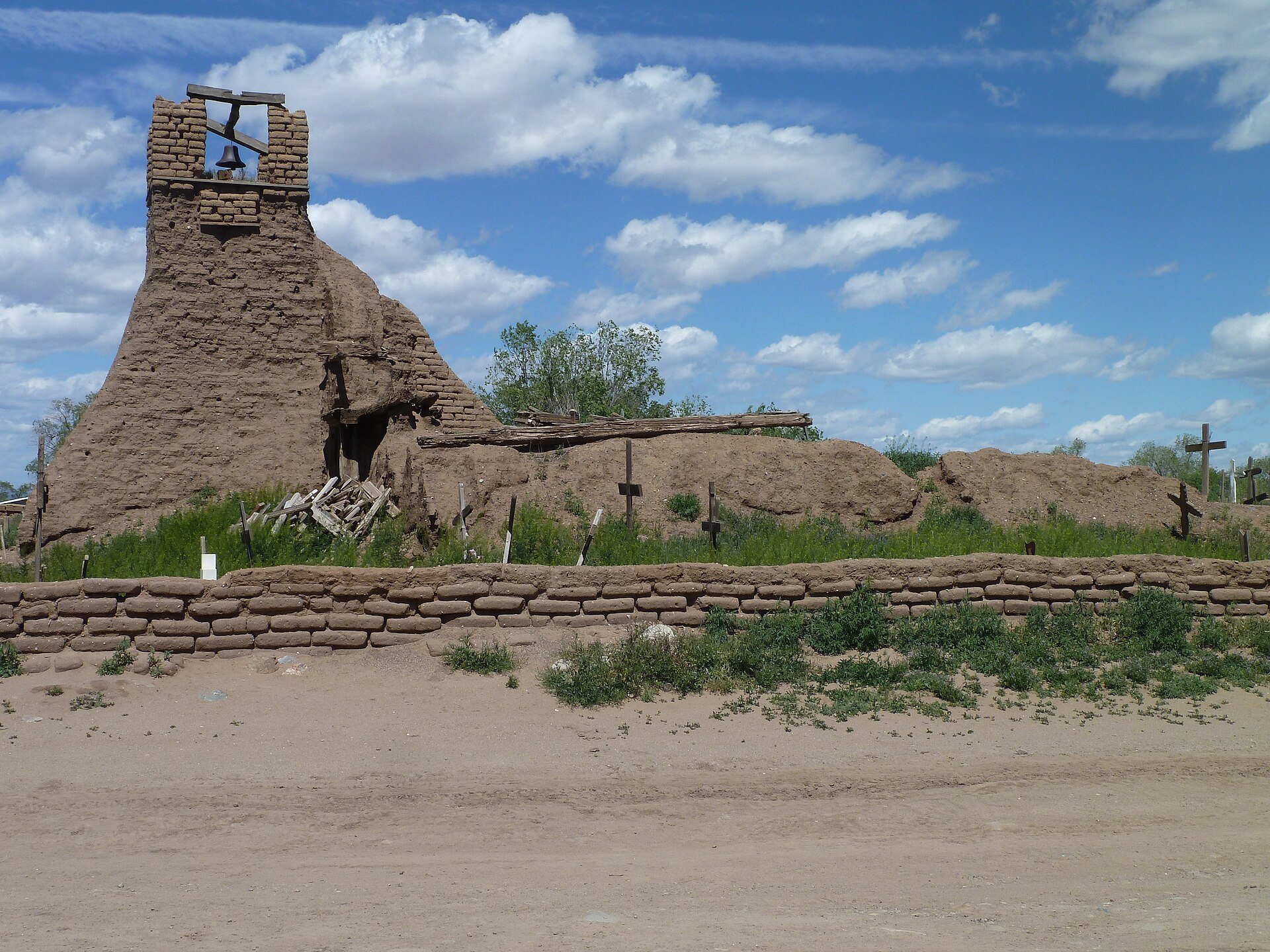
The origin of the pueblo remains partly uncertain. Pueblo refugees may have built it before 1680, or it may have been constructed by people who left New Mexico after the Pueblo Revolt, an Indigenous uprising against Spanish colonial rule in 1680, and joined the Plains Apache in 1696. The structure has also been associated specifically with Taos or Picuris communities. Its architecture resembles pueblos of the Northern Rio Grande region, while the surrounding archaeological evidence reflects a period when Apache and Pueblo residents lived in the same broader settlement area.
Spanish expeditions and regional conflict
Spanish authorities attempted to recover Pueblo refugees from El Cuartelejo. Juan de Archuleta led an expedition in 1642. In 1706, Juan de Ulibarri led another expedition, identified the principal village as Santa Domingo, and used it as his headquarters while his party gathered people from at least five Apache and Pueblo rancherias. A rancheria was a small settlement or community, often formed by several dwellings around a shared area.
The Villasur expedition passed through El Cuartelejo in 1720 while attempting to challenge French influence on the Plains. Pawnee forces defeated the expedition in present-day Nebraska. French traders reached the region in 1727, and French trading posts were established at Apache rancherias in the wider El Cuartelejo area in 1748.
Pressure from Comanche, Pawnee, and Ute groups contributed to the displacement of the Cuartelejo Apache. Apache communities left the Kansas area by the 1730s. Survivors settled with the Jicarilla Apache near Pecos Pueblo or moved onto the plains east of New Mexico, while the Comanche dominated the region by about 1760. El Cuartelejo had been abandoned as an Indigenous village by the 1730s, and the ruins later deteriorated beneath accumulating sediment.
Excavation and preservation
The name El Cuartelejo, also spelled El Quartelejo, derives from the Spanish term cuartelejo, associated with an old building or barracks. The principal archaeological site is also known as the Scott County Pueblo site and by the designation 14SC1.
Herbert and Eliza Steele homesteaded in the area in 1888. After finding Native American stone artifacts and earth mounds on their property, they contacted archaeologists. Excavations by S. W. Williston and H. T. Martin of the University of Kansas began in 1898 and continued through 1900. Their work established that Dismal River Apache communities occupied the locality before and after the period of Apache and Pueblo coexistence. Charcoal and burned artifacts within charred adobe led them to conclude that the pueblo had been destroyed by fire.
A Smithsonian Institution excavation led by Waldo Wedel examined areas north and south of the pueblo in 1939. Later investigations by the Nebraska Historical Society took place in 1970, 1975, and 1976 under A. T. Hill, followed by work led by archaeologists from the University of Oklahoma and the University of Iowa. Together, these investigations clarified the sequence of Apache and Pueblo occupation.
In 1922, two acres containing the pueblo ruins were given to the Kansas State Society of the Daughters of the American Revolution, which erected a monument there in 1925. The property is now within Lake Scott State Park. The El Cuartelejo Archaeological District became a National Historic Landmark on July 19, 1964, a United States designation for sites of exceptional historical or archaeological importance. It was added to the National Register of Historic Places on October 15, 1966. Landmark protection contributed to the reconstruction of portions of the pueblo walls and the installation of interpretive markers.
The Kansas State Society of the Daughters of the American Revolution owns the site, while the Kansas Department of Wildlife, Parks and Tourism maintains it. Since the first excavations, the remains have suffered deterioration and damage from amateur removal of artifacts. The National Park Service has classified the site as vulnerable to weather-related erosion since 2004.
Remains
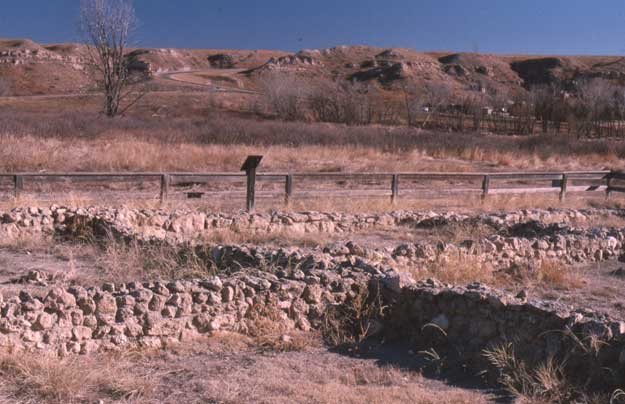
The ruins lie in Ladder Creek Canyon north of Scott City, within a landscape of springs, streams, canyon walls, and bluffs. These natural features provided shelter from severe weather and created a milder local climate than the surrounding High Plains. The principal remains consist of a seven-room pueblo built with stone and adobe, accompanied by twenty-five additional archaeological sites, irrigation features, pits, and occupation materials.
The pueblo structure
Stone and adobe rooms
The main pueblo measures approximately 16 by 11 metres, or 52 by 36 feet. It is regarded as the northernmost known pueblo in North America and the only known pueblo in Kansas. Its plastered stone walls supported a roof made from willow poles covered with plastered brush. Entry was made from above by ladder, and the building had no doors or windows. The arrangement reflects a substantial communal dwelling with Southwestern architectural origins.
Interior features
Inside the rooms were a grinding trough, ovens, slab-lined hearths, and raised platforms used for sitting or sleeping. Excavated deposits contained animal bones, stone tools, ceramics, and a large quantity of corn. The pottery included Northern Rio Grande Pueblo forms as well as Plains Native American styles. Tewa Polychrome pottery and clay pipes were also recovered, along with evidence that Pueblo women continued making pottery and preparing food according to practices from their New Mexican homelands.
Surrounding archaeological features
Pits and occupation deposits
Excavation north and south of the pueblo exposed a circular, bell-shaped pit and a cache pit located a few metres from the main structure. These features contained hundreds of stone tools, about 4,000 Dismal River ceramic fragments, pipe fragments resembling those from Northern Rio Grande pueblos, charcoal, numerous animal bones, three Olivella shells, and other discarded materials. A roasting pit beneath the pueblo demonstrates that Dismal River people occupied the locality before the later period of Apache and Pueblo cohabitation.
Irrigation ditches
Irrigation ditches extend from a nearby spring toward the settlement. They were probably used to supply water to cultivated fields, adding evidence of food production to the hunting, cooking, pottery-making, and domestic activities represented by the excavated remains.
Reconstructed and museum features
Reconstructed walls
Partial walls were reconstructed after the excavations of the 1970s to represent the pueblo’s layout as it appeared during the investigations of 1898. The surviving and reconstructed sections make the room arrangement and construction of the stone and adobe building more apparent.
Steele house and museum collections
The former Steele house, built of sandstone after the family initially lived in a dugout, now serves as a museum for Lake Scott State Park. The El Quartelejo Museum displays a model of the pueblo, scenes of early Native American camps, and artifacts and fossils associated with El Quartelejo.