Diepkloof Rock Shelter: A Middle Stone Age Archaeological Site
Site at a Glance
- Rating
- 4.1
- Popularity
- Very Low
- Country
- South Africa
- Primary era
- Stone Age
- External website
- Open
- Eras represented
- Stone Age
- Civilizations
- Unclassified
- Site type
- Domestic
On this page8 sections
History
Diepkloof Rock Shelter is a prehistoric occupation site in South Africa, preserving a later Middle Stone Age sequence that spans approximately 130,000 to 45,000 years ago. The Middle Stone Age was an African period associated with later Pleistocene developments in stone technology and early modern human behaviour. The sequence includes pre-Stillbay, Stillbay, Howiesons Poort, and post-Howiesons Poort phases, making the shelter an important record of changing human behaviour in southern Africa.
A long Middle Stone Age occupation
The deposits preserve repeated occupations across several technological traditions. Stillbay and Howiesons Poort refer to Middle Stone Age traditions identified through characteristic stone-tool industries and related archaeological remains, while post-Howiesons Poort describes the period that followed the Howiesons Poort phase. Evidence from the shelter includes changing methods of stone production, hearths, ash dumps, burnt bedding, organic remains, animal bones, and marine shells. Together, these materials preserve information about the people who used the shelter and the environments around it over many thousands of years.
Diepkloof also provides some of the earliest evidence for the use of symbolic designs. Around 60,000 years ago, people engraved geometric patterns on ostrich-eggshell water containers. The repeated designs may have expressed individual or group identity and may represent a graphic tradition used in social interaction, although their precise meaning remains uncertain.
Excavation and heritage protection
Archaeologists John Parkington and Cedric Poggenpoel began excavating Diepkloof Rock Shelter in 1973. Since 1999, research has been carried out collaboratively by the University of Cape Town’s Department of Archaeology and the University of Bordeaux’s Institute of Prehistory and Quaternary Geology.
Heritage Western Cape declared the shelter a Grade II provincial heritage site on 23 September 2014 under Section 27 of the National Heritage Resources Act. This designation identifies a site of provincial significance and gives it protection under South African heritage law. South Africa proposed Diepkloof in 2015 as part of a possible serial World Heritage nomination involving several southern African Pleistocene occupation sites. In July 2024, at the 46th session of the World Heritage Committee, it became part of the UNESCO serial World Heritage Site The Emergence of Modern Human Behaviour: The Pleistocene Occupation Sites of South Africa. The inscription uses cultural criteria concerning testimony to a cultural tradition, an important type of cultural development, and representative traditional settlement or land use.
Remains
Shelter and archaeological deposits
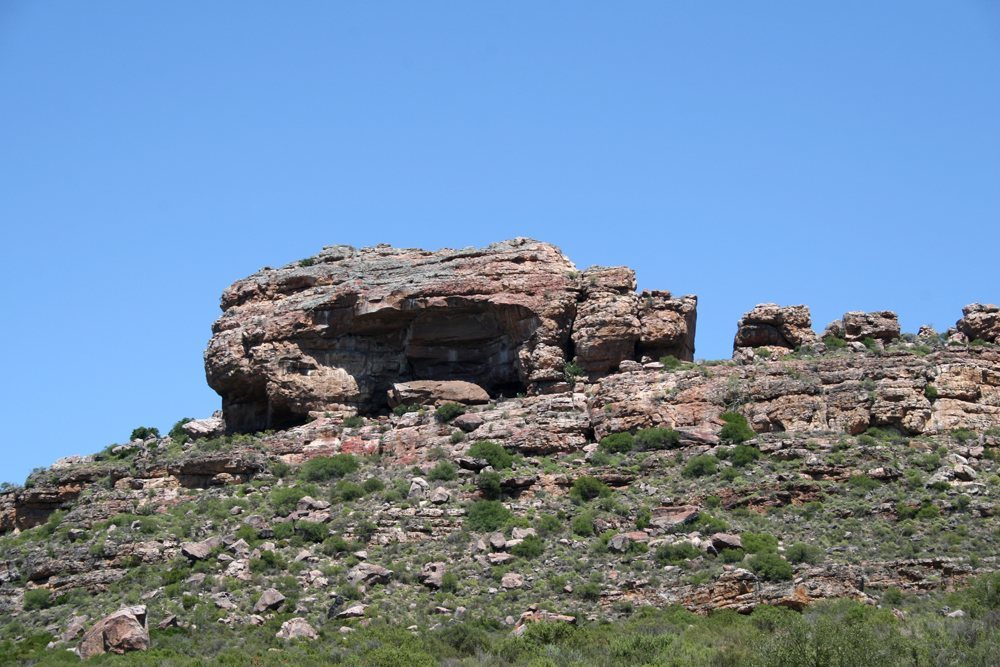
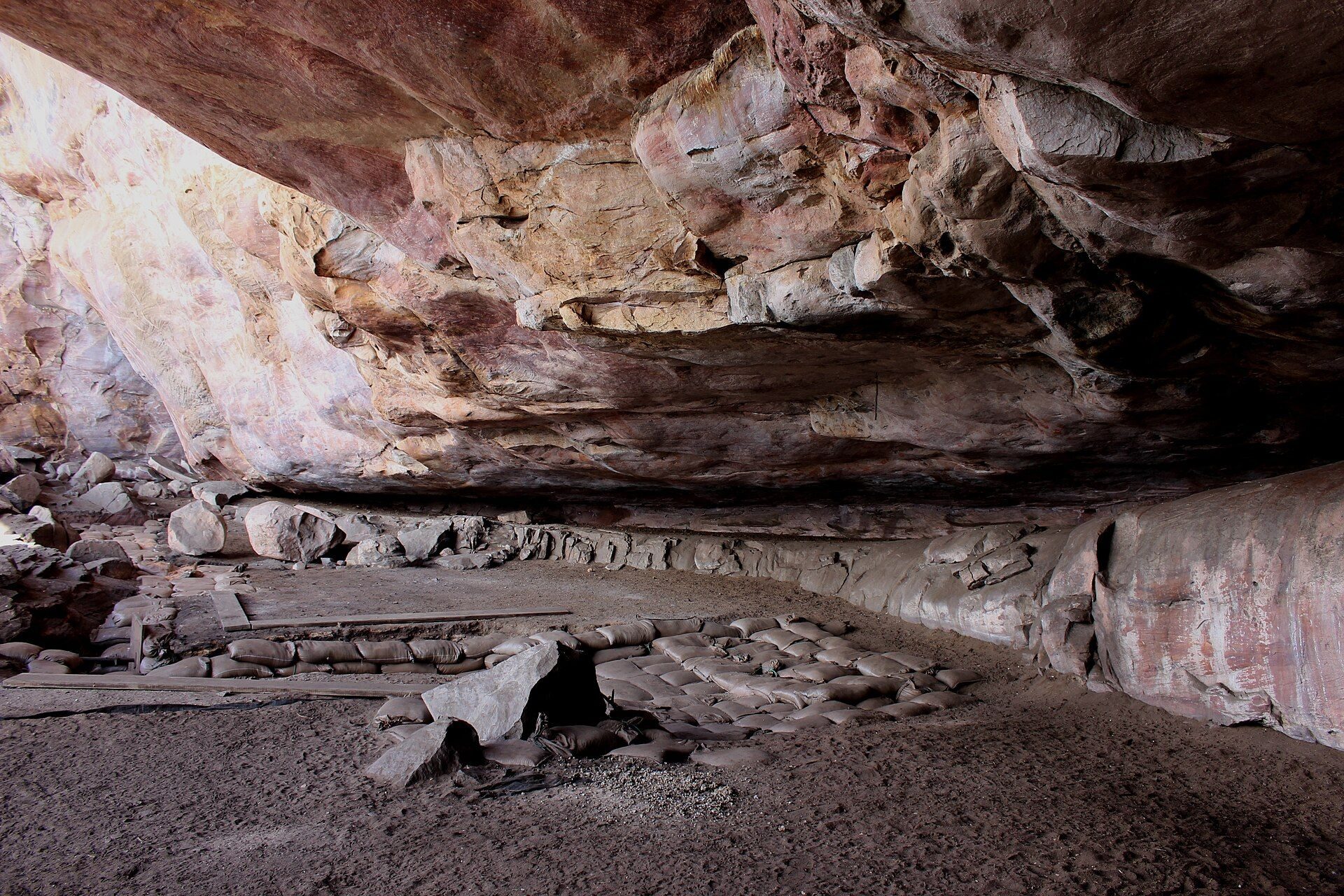
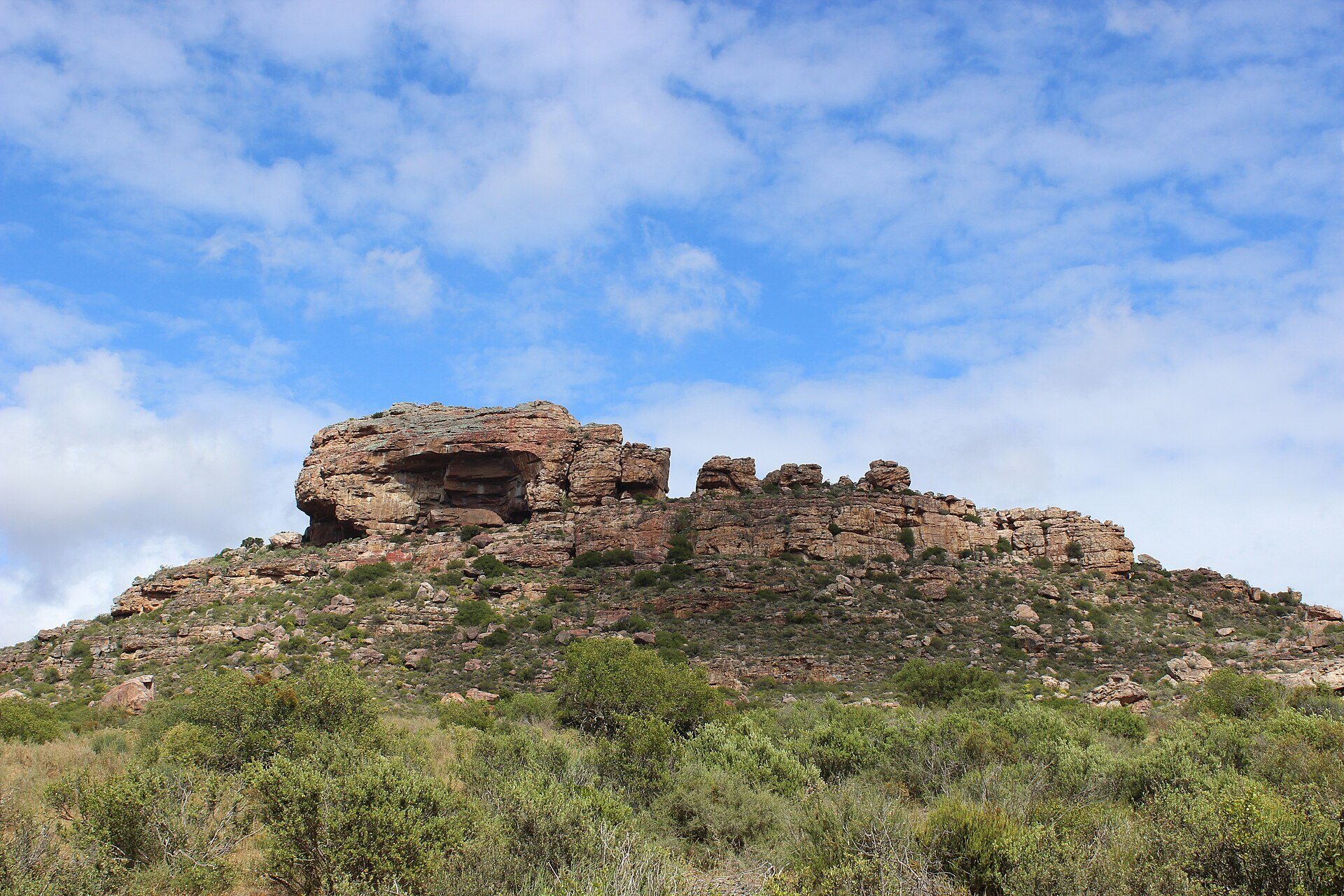
The shelter lies in quartzitic sandstone within a butte overlooking the Verlorenvlei River from approximately 100 metres above it. It is about 17 kilometres from the Atlantic shoreline, near Elands Bay, in a semi-arid area roughly 150 kilometres north of Cape Town. The cavity is approximately 25 metres wide and 15 metres deep. Archaeological work has concentrated on a trench inside the shelter, measuring about 16 metres across and reaching 3.6 metres into the deposits.
The excavated sequence contains burnt and unburnt organic residues, ash from hearths and ash dumps, and burnt bedding. Exceptional organic preservation has allowed wood, grass, seeds, fruits, and pollen to survive. These remains provide evidence for changing local conditions and help connect the human occupations with the river, surrounding vegetation, and nearby coast.
Stone tools and changing technologies
The earliest lithic units are dominated by quartz and quartzite, with only limited use of silcrete, a hard stone cemented by silica that can be worked into tools. During the phase dated to approximately 74,000 to 70,000 years ago, silcrete replaced quartz as the main material, while quartzite remained relatively common. Between about 70,000 and 65,000 years ago, quartz again became dominant, with quartzite still present.
Bifaces and bifacial points, which were worked on both faces, date to approximately 74,000 to 70,000 years ago. Less complex backed artefacts occur from about 70,000 to 60,000 years ago and were later replaced by unifacial points, which were worked mainly on one face. These changes form part of the shelter’s long sequence of technological development.
Engraved ostrich-eggshell containers
Approximately 270 ostrich-eggshell fragments carry engraved geometric designs. They represent an estimated 25 containers, and individual fragments are generally 20 to 30 millimetres across. Some pieces have been fitted together into fragments measuring 80 by 40 millimetres. Ostrich eggshell occurs throughout the occupation sequence, but the engraved pieces come from several Howiesons Poort layers.
The engraved fragments are distributed across 18 stratigraphic units, or distinguishable layers within the archaeological sequence, especially the units named Frank and Darryl. Their distribution indicates that the engraving tradition continued for several thousand years. The designs are repeated abstract linear patterns, including bands filled with short, closely spaced parallel lines. One fragment bears two parallel lines that may once have extended around an entire container.
The shells were used as water containers with an average capacity of about one litre. They may have had drinking spouts or perforations that allowed them to be attached and carried as portable canteens. The repeated geometric patterns therefore belonged to objects associated with storing and transporting water, although the social meaning of the designs cannot be established with certainty.
Plants, animals, and the surrounding environment
Plant remains from the Howiesons Poort deposits indicate thicket or shrubland vegetation, including Diospyros, Cassine peragua, Maytenus, Rhus, and Hartogiella schinoides. Afromontane trees such as Ficus, Kiggelaria africana, Podocarpus elongatus, and Celtis africana were also present. The evidence points to a more varied wooded riverine environment than the area has today.
Animal remains include mammals, tortoises, and intertidal marine shells. Rock hyraxes, hares, Cape dune mole-rats, steenbok, and grysbok make up most of the mammal bones. Other remains include klipspringer, vaalribbok, zebra, wildebeest, hartebeest, hippopotamus, and southern reedbuck. These animals represent rocky habitats, grasslands, and a local river environment.
Black mussels, granite limpets, and Cape fur seals indicate that the sea coast once extended farther up the river. Ostrich eggshell is present among the remains, while the tortoise bones mainly belong to angulate tortoises, a species that still occurs locally. These tortoises were remarkably large compared with Late Stone Age examples, suggesting differences in hunting pressure between Middle Stone Age and Late Stone Age populations.
Sixty-one cat-skeleton fragments come from layers dated to approximately 100,000 to 70,000 years ago. They consist mainly of toe bones, metapodials, and jaw bones, and represent the African wildcat and leopard. Other fragments may belong to either serval or caracal, since the two species cannot be reliably distinguished from these remains.