Galden Jampaling Monastery: A Gelug Buddhist Center in Chamdo
Site at a Glance
- Rating
- 4.7
- Popularity
- Very Low
- Country
- China
- Primary era
- Medieval
- Eras represented
- Medieval, Modern
- Civilizations
- Tibetan
- Site type
- Religious
- Remains
- Monastery
On this page16 sections
History
Galden Jampaling Monastery, also known as Chamdo Monastery, is a Tibetan Buddhist monastery in Karuo District, Chamdo, China. Founded in the fifteenth century in the Tibetan architectural tradition, it became a major center for the spread of the Gelug school in Kham and was described as the earliest and largest Gelug monastery in the region.
Foundation and Gelug expansion
A small religious establishment stood on the site before the present monastery was founded. Tibetan religious tradition holds that Tsongkhapa, the fourteenth- and fifteenth-century scholar who founded the Gelug school, passed through Chamdo in 1373 while traveling from Qinghai to Lhasa. After spending a night at the future monastery site, he is said to have dreamed of the Arhat Bakula and predicted that the meeting of the two rivers would be an auspicious place for a major Buddhist center.
Jangsem Sherab Sangpo, a disciple of Tsongkhapa and one of six major advocates of Buddhism in the frontier regions, established the monastery and became its first abbot. It was his first major Gelug foundation in Kham. The foundation is dated variously between 1436 and 1444, with 1437 and 1444 most often given. The 1444 date is associated with a biography written by Sherab Sangpo’s direct disciple Sangye Sangpo and is regarded as the better-supported tradition. A date of 1347 conflicts with the founder’s recorded lifetime and is not considered credible.
The monastery was first called Choko Jampaling, a name referring roughly to a Dharma Wheel and Maitreya, because Maitreya was reportedly its principal deity. Later names included Chamdo Jampaling and Chamdo Gompa, while Chinese names included Jushan Mile Temple and Zhuli Temple. Its foundation initiated organized Gelug missionary activity in Kham, and historical tradition credits the monastery with helping the school spread through the region’s principal areas.
Pagbalha leadership and Qing recognition
The Pagbalha line, a succession of incarnate lamas regarded as rebirths of earlier teachers, became the monastery’s leading religious and institutional lineage. In 1594, the Third Pagbalha, Pagbalha Tongwa Dondrup, became the fourteenth lineage abbot. This established the practice by which Pagbalha incarnations presided over Galden Jampaling. When a Pagbalha was deceased or too young to lead, an incarnation from the Shewala, Jiare, or Gondo line could administer religious and secular affairs.
Galden Jampaling historically had five major incarnate-lama lineages: Pagbalha, Shewala, Jiare, Gondo, and another lineage also rendered Jiare in English. The Qing Lifanyuan, the imperial office responsible for relations with Tibet, Mongolia, and other Inner Asian peoples, registered these lineages and granted several of them titles or seals during the eighteenth and nineteenth centuries.
The monastery maintained close relations with the Qing imperial court. In 1719, the Kangxi Emperor granted the Sixth Pagbalha Hutuktu, Pagbalha Jigme Tenpe Gyatso, an official title and a bronze seal, and bestowed the name Jushan Mile Temple on the monastery. During the tenure of the Seventh Pagbalha, a temple was built for celebrations of the Qianlong Emperor’s eightieth birthday. In 1791, the emperor supplied the inscription for a plaque naming the monastery Zhuli Temple.
Religious and territorial administration
Before the People’s Republic period, the Pagbalha exercised both religious and administrative authority in the Chamdo domain. The monastic office managed religious affairs, while a separate administrative office governed the surrounding territory. Religious officials were responsible for hospitality, documents, lamps, commerce, and other institutional functions. Its highest council included teachers from five major monastic colleges, heads of eight meditation institutions, the official supervising offerings, and senior scripture teachers.
The secular administration was headed by a general administrator. After the Tibetan government established a Chamdo general-administration office in 1918, the Pagbalha nominated this official, who was appointed by the Dalai Lama and the regent. The administration oversaw five districts and eighteen local administrative areas, with subordinate officials handling estates, legal affairs, supervision, documents, construction, and building maintenance.
Galden Jampaling reached its greatest influence during the periods of the Sixth and Seventh Pagbalha incarnations. At different times, it controlled or supervised approximately 70 to 130 subsidiary monasteries. Tradition says that the monastery had 3,000 monks when Sherab Sangpo founded it and more than 2,000 in the early nineteenth century. At its height it housed more than 5,000 monks, although another figure gives approximately 2,500. Modern descriptions place its resident community at about 800 to more than 1,000 monks.
Destruction, rebuilding, and protection
Major buildings were destroyed by the Bairi ruling house in the seventeenth century. On 12 May 1912, troops commanded by Peng Risheng burned the monastery. The main hall, which was then being used as a prison, and two other buildings survived. Tibetan forces took Chamdo, and rebuilding began in 1917.
The monastery suffered extensive damage during the Cultural Revolution. Restoration began after 1982, following the first Tibet work conference in 1980, and the complex was rapidly rehabilitated. Religious activities were restored alongside the buildings, including the Guqing masked guardian dance, the axe-and-adze dance, Chamdo Tibetan opera, and the distinctive religious dance called zhuo. Revived observances include the butter-lamp and butter-sculpture festival, the Maitreya reception ceremony, the lamp festival, and a late-winter masked exorcism and send-off ritual.
A democratic management committee was established during the People’s Republic period and replaced by a monastery management committee in October 2011. Zongluo Xiangbakezhu served as the long-term director and became the first director of the successor committee. Galden Jampaling was designated a protected cultural site of the Tibet Autonomous Region in 1962. On 5 March 2013, it entered the seventh list of major nationally protected historical and cultural sites of China.
Remains
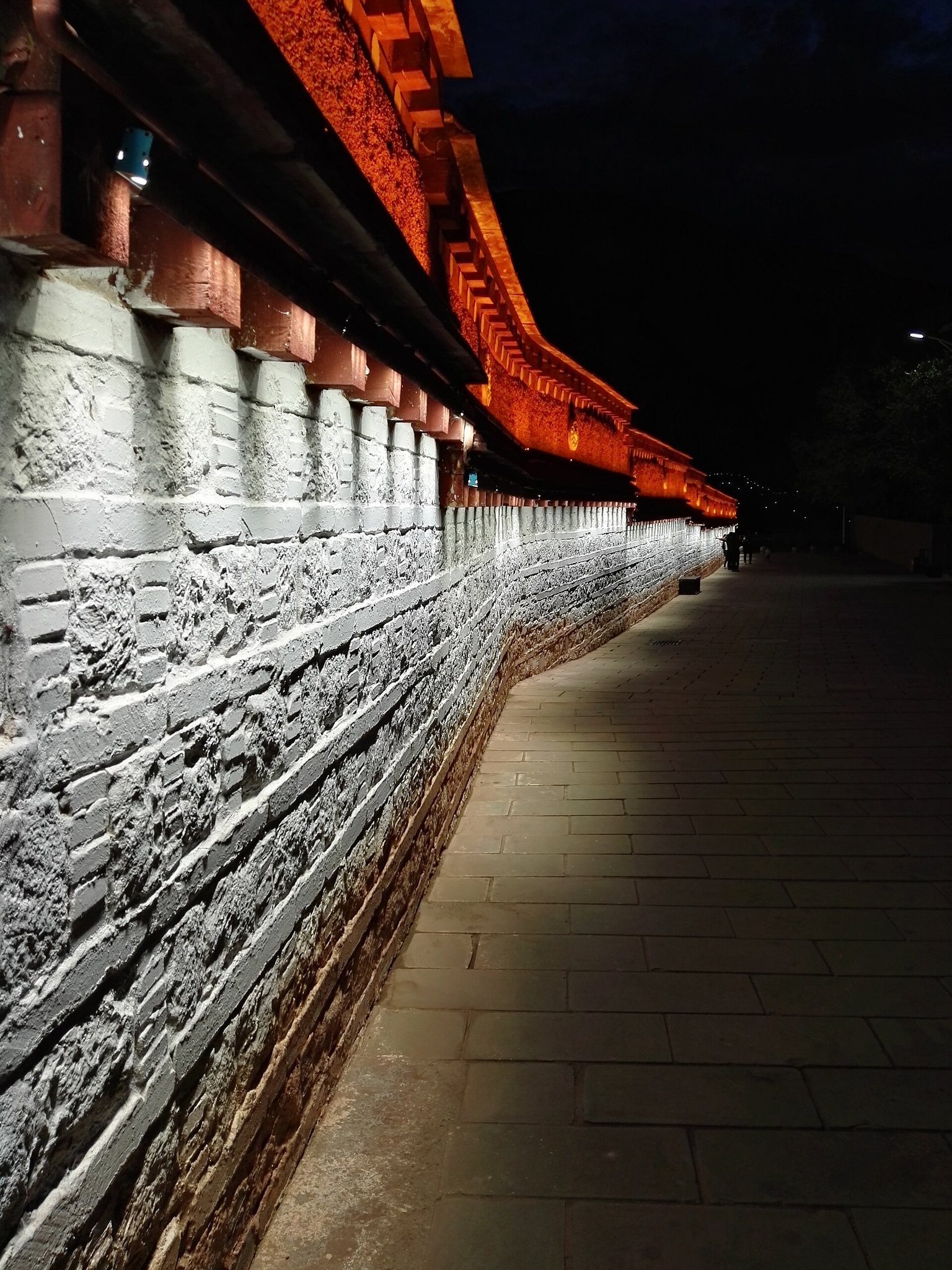
Galden Jampaling occupies the fourth of four terraces on Malashan, also called Dagmala or Dragon Mountain, at the confluence of the Dza Chu and Ngom Chu rivers in the upper Mekong basin. The complex faces east and covers approximately 500 mu of building area. Its Tibetan-style buildings are arranged around the Great Scripture Hall, courtyards, colleges, meditation institutions, subsidiary halls, residences, and ritual structures. A description from 1792 characterized the monastery as broad and imposing, with halls, courtyards, and a gilded roof.
Central halls and religious buildings
Great Scripture Hall
The Great Scripture Hall is the principal building of the monastery. It survived the fire of 1912, although its present form includes later repair and restoration. The hall now has a gold-colored hip-and-gable roof crowned by a Dharma wheel with reclining deer. It contains hundreds of Buddha and eminent-monk images, many thangka paintings, sacred objects, and Tibetan scriptures. Several thousand Buddhist images and thangkas were returned and reinstalled after the restoration period.
Newly made large images of Shakyamuni, Maitreya, and Tsongkhapa with his two principal disciples stand among images of former monastic leaders. A gilded alloy statue of Shakyamuni was installed for worship under the direction of Yongzeng Tudeng Tangba, the scripture teacher of Pagbalha Geleg Namgyal. Artists of Chamdo’s Maisha painting tradition, led by Jiayong Langjie, also painted new murals covering several thousand square meters inside the hall.
Associated halls and palaces
Buildings around the central hall include a protector hall, two Tara halls, a scripture-debate courtyard, the Gedorlha Palace, the Galdan Phobrang Palace, a practice hall, and an engraving or scripture-printing hall. The protector hall, the principal scripture halls of the eight meditation institutions, the Tara halls, and eight auspicious stupas were rebuilt according to their former designs. Repairs also restored the scripture halls of the doctrinal institutions and the residences of the Pagbalha, Shewala, and Jiare lineages.
Colleges, meditation institutions, and residences
Monastic colleges
The complex contains nine principal monastic colleges, institutions organized for Buddhist study and practice. Five older colleges were traditionally regarded as the original group: Lindui, Linmei, Nulin, Yedang or Kuyu, and Jiangre. Lindui and Jiangre were described as the earliest. Four colleges were established later. Earlier descriptions refer to twelve colleges, while later accounts distinguish nine principal colleges, five major colleges, and eight meditation institutions. These figures reflect different phases or systems of organization rather than one uniform arrangement.
Meditation institutions and lineage residences
Eight meditation institutions, more than twenty scripture halls, a debate ground, numerous monks’ residences, and five residences belonging to the major incarnate-lama lineages form other parts of the complex. Their surviving and restored buildings express the institutional structure through which Galden Jampaling organized teaching, meditation, debate, and lineage leadership.
Stupas, monumental display, and surviving objects
Auspicious stupas
Eight large auspicious stupas stand among the monastery’s rebuilt ritual structures. They form part of the complex restored after the destruction of the twentieth century, together with the protector and Tara halls.
Thangka display tower
The highest structure in the complex is a four-level stone building approximately 18 meters high. It is used to display a monumental cloth thangka of Maitreya measuring about 16 meters by 8 meters.
Imperial seal and sacred collections
The monastery preserves the bronze seal granted to the Pagbalha lineage by the Kangxi Emperor in 1719. Its collections also include numerous Buddhist statues made from metal, wood, and clay, along with sacred objects, Tibetan scriptures, and painted or embroidered thangkas. Together with the restored murals and reinstalled images, these objects form part of the religious furnishings preserved in the monastery’s halls.