Battle of Blackstock’s Historic Site: Revolutionary War Battlefield
Site at a Glance
- Rating
- 4.4
- Popularity
- Very Low
- Country
- United States
- Primary era
- Early Modern
- External website
- Open
- Eras represented
- Early Modern
- Civilizations
- Unclassified
- Site type
- Military
On this page8 sections
History
Battle of Blackstock’s Historic Site in Enoree, South Carolina, United States, preserves the battlefield of an American victory fought on November 20, 1780, during the American Revolutionary War. The conflict, which lasted from 1775 to 1783, pitted the thirteen American colonies against British rule. The engagement took place at William Blackstock’s farm near Cross Anchor, in what is now Union County, and became known as the Battle of Blackstock’s Farm, Blackstock’s Plantation, Blackstock’s Hill, or Blackstocks.
From Kings Mountain to Blackstock’s Farm
The battle followed the October 1780 defeat of Major Patrick Ferguson and the destruction or capture of his 900-man Loyalist force at Kings Mountain. Loyalists were colonists who supported the British Crown, while Patriots supported American independence. After Kings Mountain, the Carolina Backcountry increasingly came under Patriot control.
British commander Lieutenant General Charles Cornwallis ordered Lieutenant Colonel Banastre Tarleton and his British Legion, a mounted force used against Patriot militia, to stop pursuing Patriot guerrilla commander Francis Marion. Tarleton was instead directed to disrupt the militia led by Brigadier General Thomas Sumter and restore confidence among Backcountry Loyalists. Sumter had gathered about 1,000 militiamen, while Tarleton commanded roughly 270 British regulars and militia.
On November 18, Tarleton’s dragoons and mounted infantry of the 63rd Regiment encountered Sumter’s raiders across the Broad River. A light field gun known as a grasshopper dispersed the raiders. Tarleton then crossed the river in flatboats and continued the pursuit. A deserter from the 63rd Regiment revealed Tarleton’s plans and position to the Americans, giving Sumter time to select stronger ground.
The Engagement of November 20, 1780
Sumter and his colonels chose a defensive position instead of meeting Tarleton in open ground. Colonel Thomas Brandon, who knew the local terrain, recommended William Blackstock’s nearby farm. Its cleared fields and buildings provided defensive advantages, while fences, woods, a creek, and the surrounding hills limited the approaches available to attacking troops.
Tarleton attacked late on November 20, before all of his infantry and artillery had arrived. The 63rd Regiment initially advanced successfully, but Major John Money and two of his lieutenants were killed after the regiment approached the farm buildings. Other Patriot troops attacked the flank of Tarleton’s mounted force. Tarleton then led a charge uphill to relieve the 63rd Regiment. Many dragoons and horses were wounded, and Tarleton personally carried the badly wounded Major Money to safety.
During the British withdrawal, Sumter moved forward to observe the retreat and was severely wounded by a volley from the 63rd Regiment. He gave command to his senior colonel, John Twiggs. Tarleton withdrew about two miles and waited for reinforcements, but Twiggs left burning campfires and withdrew during the night. The following morning, Tarleton’s troops buried the dead of both sides.
Results and Historical Memory
Tarleton reported that 51 of his men had been killed or wounded, while other estimates placed British losses at 92 dead and between 75 and 100 wounded. American losses were three killed, four wounded, and 50 captured. Tarleton told Cornwallis that he had broken up and dispersed the American force and seriously wounded Sumter. He also reported that three soldiers had promised to kill Sumter immediately and that he had offered each of them fifty guineas.
Although Tarleton held the field, the engagement showed that militia could halt British regulars when fighting from prepared cover rather than in open battle. The action was regarded as the first American militia victory over British regulars during the war, with the qualification that the Americans outnumbered the British by three to one and occupied a prepared position. Battle of Blackstock’s Historic Site was added to the U.S. National Register of Historic Places on December 16, 1974.
Remains
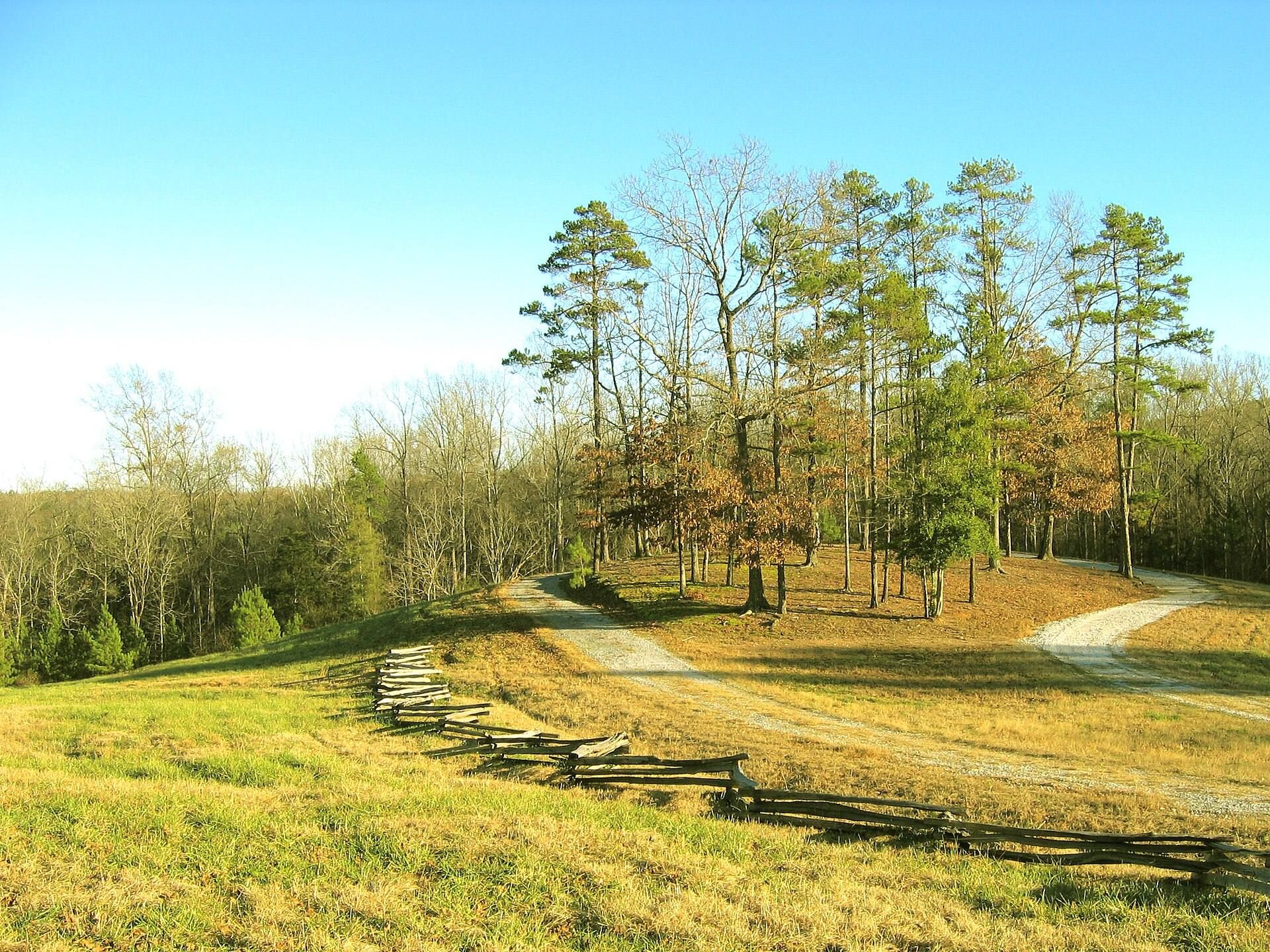
The historic site encompasses approximately 540 acres, or 220 hectares, west of Union near South Carolina Highway 49. The battlefield occupied hills above the Tyger River at William Blackstock’s farm. Its physical setting combined cleared fields, farm buildings, fences, a creek, surrounding woods, and the nearby river, creating both open approaches and protected defensive positions.
Farmstead and Defensive Ground
Farm Buildings
The farm outbuildings were built as sturdy hardwood log structures. Their walls were unchinked, so narrow gaps remained between the logs and could be used by defenders as firing openings. Colonel Henry Hampton’s South Carolina riflemen occupied these buildings during the battle, using the farmstead as a protected position against the advancing 63rd Regiment.
Fields, Fences, and Woods
The cleared land around the farm provided fields of fire and room for maneuver, while attacking troops had to cross open ground, fences, and a creek. Other Patriot units held positions behind strong fences and in the surrounding woods. The hills above the Tyger River, together with these natural and constructed features, shaped the approaches and defensive arrangement of the battlefield.