Palyul Monastery: A Principal Mother Monastery of the Nyingma Tradition
Site at a Glance
- Rating
- 4.6
- Popularity
- Very Low
- Country
- China
- Primary era
- Early Modern
- Eras represented
- Medieval, Early Modern, Modern
- Civilizations
- Tibetan
- Site type
- Religious
- Remains
- Monastery
On this page18 sections
History
Palyul is a Nyingma Buddhist monastery in Baiyu County, Garzê Tibetan Autonomous Prefecture, Sichuan, China. Founded in 1665 by Rigzin Kunzang Sherab, it became one of the six principal Mother Monasteries of the Nyingma tradition, the oldest major school of Tibetan Buddhism. The name originally referred to the place, while the monastery became known as Palyul Monastery or Palyul Gonpa and the lineage connected with its masters and teachings became known as the Palyul tradition.
Early Religious Traditions
Local traditions connect the site with the Tibetan princess Wencheng, who is said to have planted a tree there, and with the translator Vairochana, who planted a cypress and made a prophecy. These signs were understood in relation to a prophecy attributed to Padmasambhava, the Indian Buddhist master traditionally credited with establishing Buddhism in Tibet. The prophecy concerned the future flourishing of Buddhism south of Kathok.
The site also has an earlier Nyingma history. In 890, a Nyingma master came to Baiyu to practise, and a meditation cave and sacred stupa associated with this activity are said to survive. The place is described as the first Nyingma religious center in Kham-Tibet. A shrine was later built on the rock fort at the original site, preserving the connection between the earlier sacred location and the later monastery.
Foundation and Expansion
In 1665, Rigzin Kunzang Sherab founded Palyul Monastery and became its first throne-holder, the senior lineage holder responsible for transmitting religious teachings and institutional authority. In 1675, the Dege king vowed to build a monastery and enlarged the existing shrine at the original site. Rigzin Kunzang Sherab became the Dege king’s religious teacher after being invited by the terton Mingyur Dorje and another religious master. A terton was a treasure revealer believed to discover teachings concealed for later generations.
The Palyul tradition expanded through the work of Rigzin Kunzang Sherab’s disciples. At one stage, it was linked with more than 100 subsidiary monasteries and over 1,000 retreat centers and meditation facilities across Kham, Tibet, and Amdo. The principal affiliated monasteries are now described as numbering more than 360. During its period of greatest prosperity, the monastery housed about 3,000 people and produced numerous highly accomplished Buddhist masters.
Palyul became the principal seat of the Nam Chö terma, or concealed religious treasure, associated with Mingyur Dorje. Its transmission preserves teachings identified with Dzogchen, also called the Great Perfection or Ati Yoga, as well as Gagyang Dharma, Mahayoga, Mahamudra, and Vinaya Pratimoksha, the monastic discipline and individual liberation vows preserved in Buddhist ordination traditions. These lineages trace their transmissions through figures including Samantabhadra, Vajradhara, Padmasambhava, Tilopa, Naropa, Marpa, Milarepa, and Shakyamuni Buddha. Dartang Monastery in Golok is a branch of Palyul Monastery.
Modern Lineage and Destruction
The lineage’s eleventh throne-holder was Drubwang Padma Norbu, widely known as Penor Rinpoche. After his death in March 2009, Karma Kuchen Rinpoche became the twelfth throne-holder. The current throne-holder has resided at Namdroling Monastery in Bylakuppe, India, since exile from Tibet.
During the Cultural Revolution, Palyul Monastery was completely destroyed. It reopened as a religious site in the early 1980s with government approval. Reconstruction was led by the monastery’s abbot, with support from Penor Rinpoche and devotees in Tibet and abroad. The work restored the monastery’s institutional functions, including its scripture hall, Buddha halls, Buddhist college, retreat centers, meditation facilities, and monks’ residences.
In the early twenty-first century, the complex added a mandala dedicated to Padmasambhava’s Pure Land, a relic stupa for Mingyur Dorje, eight auspicious relic stupas, and newly made Buddhist statues. Palyul continues to hold major religious assemblies devoted to the Karma teachings, tenth-day practices, the Eight Heruka Deities, Padmasambhava’s wrathful practices, Vajrakilaya, and Simhamukha. Vajra dances form part of the major assemblies. The monastery is designated as a Sichuan provincial cultural relic protection site.
Remains
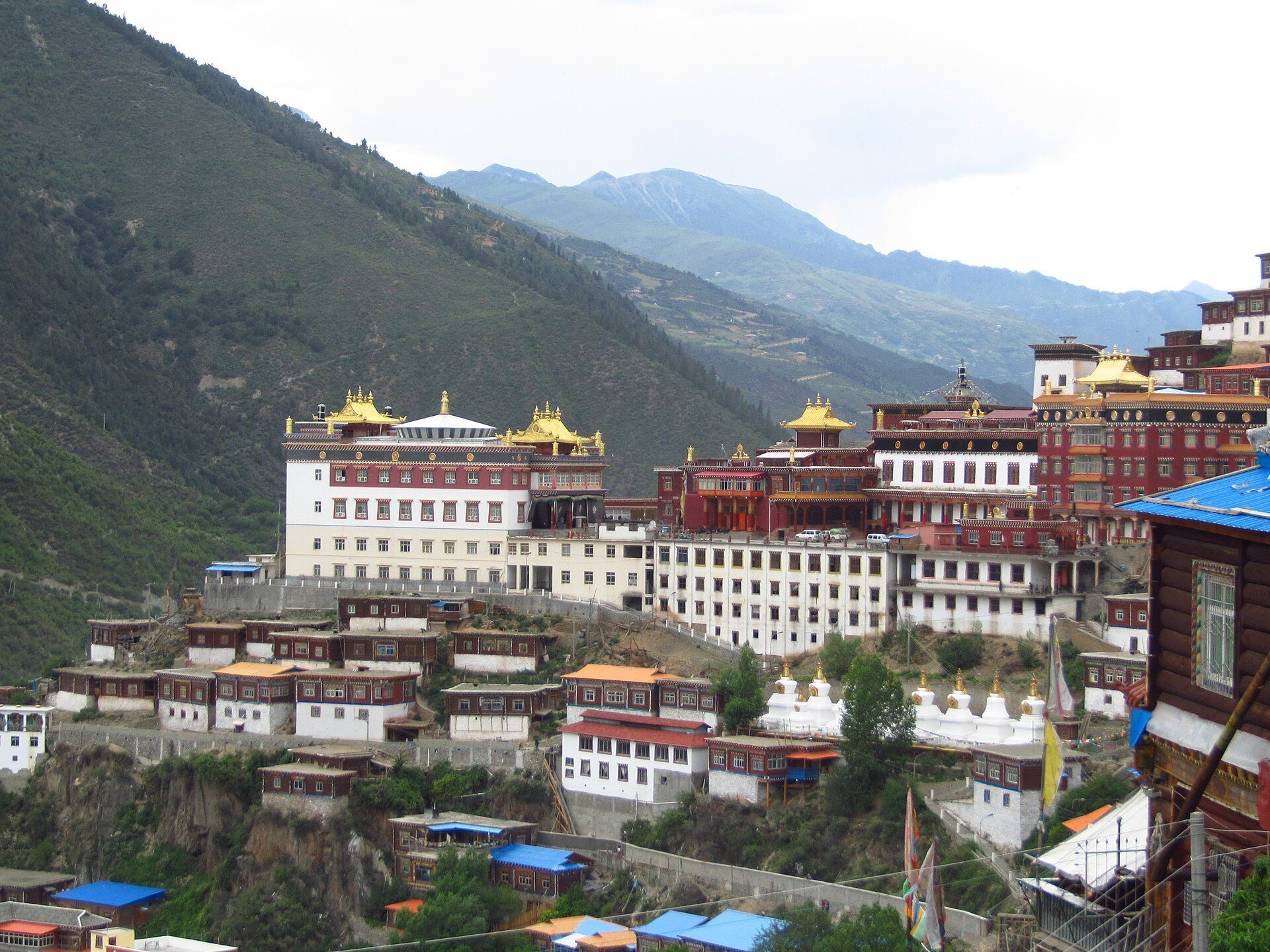
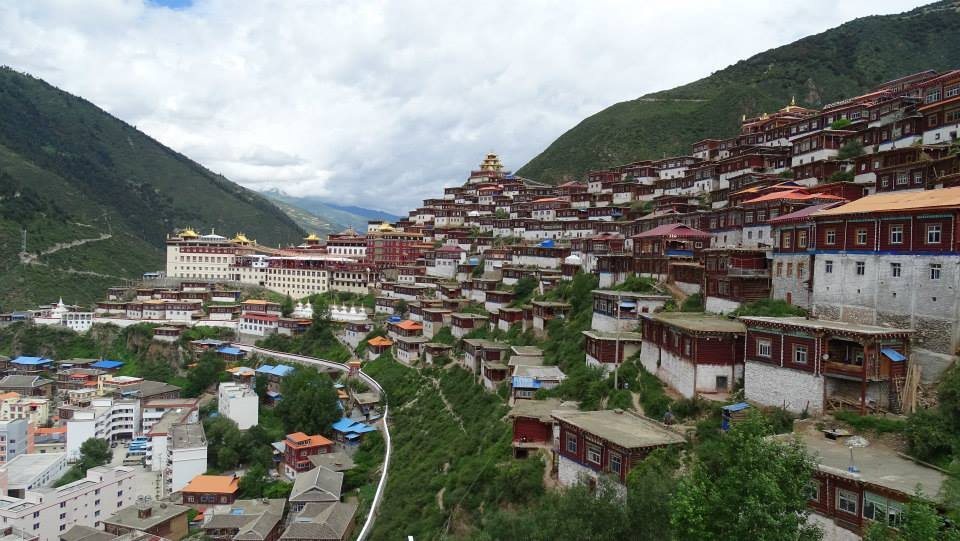
Palyul Monastery stands beside the Jinsha River in Baiyu County, at an average elevation of about 3,030 metres and amid surrounding mountains. The complex occupies a mountain above Baiyu County, where halls and smaller buildings form a large, densely built religious and educational center. Its physical remains combine early sacred features associated with the original religious site, reconstructed monastic buildings, retreat institutions, educational facilities, and later stupas, mandalas, and images.
Early Sacred Site
Meditation Cave and Stupa
The earliest surviving religious features are a meditation cave and a sacred stupa associated with the Nyingma master who practised at Baiyu in 890. The stupa is a Buddhist reliquary monument. These features belong to the earlier practice site that preceded the foundation of the monastery and are connected with the tradition that identifies the location as the first Nyingma religious center in Kham-Tibet.
Rock Fort Shrine
A later shrine was built on the rock fort at the original site. Its position preserves the relationship between the earlier sacred landscape and the monastery that developed there after the Dege king expanded the shrine in 1675.
Retreat and Meditation Institutions
Light Meditation Retreat Center
The Light Meditation Retreat Center was rebuilt between 1988 and 1990. It can accommodate 50 monks at the same time, with a separate retreat room for each monk. Its communal-practice hall contains images of the Buddha’s three bodies, statues of major treasure revealers, ritual treasures from the terma tradition, and a complete mandala of the Three Accomplishments practice. A mandala is a ritual diagram or three-dimensional sacred arrangement used in tantric Buddhist practice.
Deity Retreat Center
The smaller Deity Retreat Center is used by lamas undertaking deity practices. More than 20 monks remain there in retreat, including practitioners of Vajrakilaya.
Mind-Training Center
The Mind-Training Center provides a secluded place for lamas preparing to enter longer retreat and for lay disciples undertaking mental training. Together with the other retreat institutions, it forms part of the monastery’s reconstructed network of facilities for sustained religious practice.
Educational and Residential Complexes
Nyingma Higher Buddhist College
The Nyingma Higher Buddhist College occupies more than 50,000 square metres and follows a traditional Tibetan architectural style. Its buildings include teaching rooms, a large Buddha hall, a debate courtyard, nine classrooms for different levels, residences for khenpos, 350 student rooms, a library, an archive, a dining hall, reception and storage rooms, and a garage. A khenpo is a senior Tibetan Buddhist monastic scholar and teacher. The outdoor areas of the college were landscaped.
Attached School
An attached school added in 1998 provides instruction in Tibetan language, grammar and poetry, Chinese, religious ritual, calendrical calculation, and traditional crafts. It extends the educational functions of the monastery beyond higher Buddhist study.
Scripture Collections and Sacred Objects
Karma Printing Blocks
The monastery’s collection of Karma woodblocks was destroyed and gradually reconstituted. From 1983, more than 50,000 pages of Karma printing blocks were produced for teachings collected in 120 volumes. A six-storey scripture library was planned in 2003 to house the blocks, with each floor covering approximately 1,100 square metres.
Relic and Ritual Features
A sacred object preserved at Palyul is the skull of Pema Rinzin, a disciple of the first Penor Rinpoche. It is said to bear naturally formed images of a Buddha and the letter “A.” The early twenty-first-century additions include a mandala dedicated to Padmasambhava’s Pure Land, a relic stupa dedicated to Mingyur Dorje, eight auspicious relic stupas, and numerous newly sculpted Buddhist images.