Nikolo-Korelsky Monastery: A Russian Orthodox Maritime Gateway near Severodvinsk
Site at a Glance
- Rating
- 4.7
- Popularity
- Very Low
- Country
- Russia
- Primary era
- Early Modern
- Eras represented
- Early Modern
- Civilizations
- Russian
- Site type
- Religious
- Remains
- Monastery
On this page16 sections
History
Nikolo-Korelsky Monastery is a Russian Orthodox male monastery in Russia, near present-day Severodvinsk, whose first recorded foundation existed by the fourteenth century on the shore of the Nikolskoye estuary of the Northern Dvina. Its foundation tradition attributes the monastery to Saint Euphemius of Karelia, an Orthodox missionary associated with the conversion of the Karelians. The monastery is known from 1419 and later became a maritime gateway of the Russian state.
Medieval foundation and rebuilding
Scandinavian raiders devastated the monastery in 1419, and a fire followed in 1420. It then remained deserted for roughly half a century. In 1471, the sons of Marfa Boretskaya, a politically influential Novgorod landholder and widow of a posadnik, a senior municipal and administrative official, drowned in the White Sea under uncertain circumstances. They were buried at the monastery.
Marfa Boretskaya ordered the monastery rebuilt and commissioned a church dedicated to Saint Nicholas. She also transferred meadows, saltworks, fishing rights, and other property to the institution. Saint Euphemius’s relics were discovered there in 1647, strengthening the monastery’s religious associations.
A northern maritime gateway
For centuries, the monastery stood on a route linking Russia with northern Europe. Russian envoys could travel down the Northern Dvina and then follow the sea route around the Kola Peninsula. In 1496, Grigory Istoma used this route, with the monastery serving as the last Russian stopping place on the journey.
Western expeditions also reached the monastery and its harbor. In 1553, Richard Chancellor’s expedition entered the White Sea, stopped near Nenoksa, and anchored beside the monastery after recognizing that the region was Muscovy rather than India. The opening of this maritime connection was followed by the establishment of the Muscovy Company in London, an English trading company formed to develop commerce with Muscovy. Trade through the local harbor helped the monastery prosper.
In 1555, an anchorage called Saint Nicholas Roadstead was established opposite the monastery on Yagry Island. A roadstead is a sheltered offshore anchorage where ships can lie at anchor near a coast or harbor. Warehouses and houses grew around it, and cargo was transferred from sea-going vessels to smaller river craft bound for Kholmogory and then onward into Russia. Expeditions associated with Stephen Borough, Spark, and Anthony Jenkinson also used or departed from the area.
Decline of the port and monastic imprisonment
The monastery’s commercial importance declined after the foundation of Novokholmogory in 1584. The settlement became known as Arkhangelsk from 1613 and developed into the principal seaport of northern Russia. The settlement around Nikolo-Korelsky Monastery later contributed to the development of modern Severodvinsk.
From 1620, the monastery also operated a prison for political and religious opponents of the authorities. Its prisoners included Ivan Neronov; the Solovetsky monk Gerasim Firsov and the monk Iona, detained in 1653; and twelve Solovki rebels held in the late 1670s. Former Archbishop Feodosy Yanovsky was imprisoned there in 1725 and died there in 1726. Metropolitan Arseny Matseevich was held at the monastery from 1763 to 1767 after losing his rank for opposing Catherine II’s measures to secularize church property. Metropolitan Ignaty Smola is also listed among its prisoners.
Stone construction and later monastic status
Stone construction began in the second half of the seventeenth century. The Assumption Church was built between 1664 and 1667, Saint Nicholas Cathedral between 1670 and 1674, and the bell tower in 1700. The monastery maintained its own small brickworks. In 1764, reforms that transferred church property to state administration made it a non-coenobitic third-class monastery. In a non-coenobitic monastery, monks did not necessarily hold all property and resources in common.
Mikhail Lomonosov departed for Moscow in 1731 in a convoy belonging to the monastery. The institution continued to occupy a place in the region’s religious and transport networks until the upheavals of the twentieth century.
Industrial transformation and conservation
The Bolsheviks closed the monastery in the 1920s. During the 1930s, the Sevmash shipbuilding works and associated industrial buildings were constructed around the former monastery. By 1938, the site lay within the enterprise’s restricted territory. Former churches were incorporated into the plant and used by its departments. Sevmash initially built surface warships and later specialized in constructing and repairing nuclear submarines.
Most of the seventeenth-century wooden enclosure was dismantled, and one surviving gate tower was moved to the Kolomenskoye Museum in Moscow. Part of the monastery buildings was transferred to the Russian Orthodox Church in the 1990s, although access remained restricted because the site lies within a secure industrial facility.
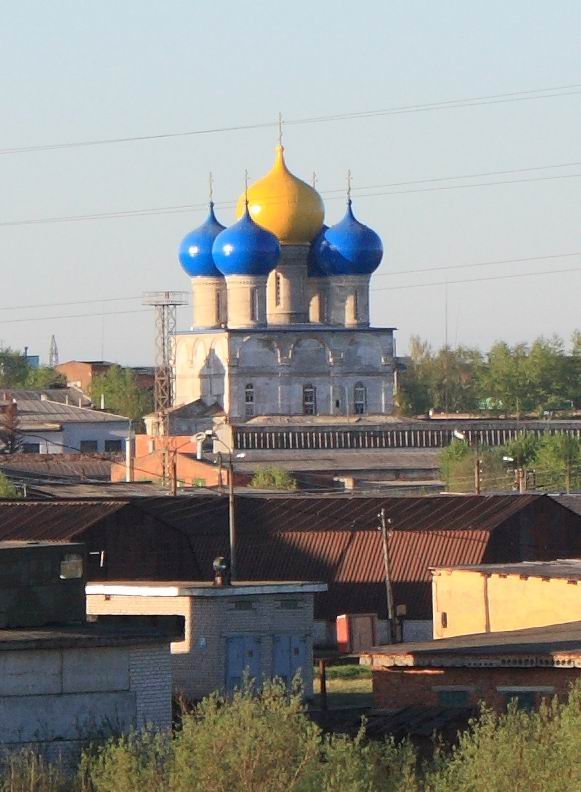
Saint Nicholas Cathedral was the first major building to undergo restoration. The first Divine Liturgy held there after the monastery’s closure took place on 7 April 2005. Plans for conservation and emergency stabilization emerged in 2023, and archaeological investigations were carried out by the Northern Expedition of the Institute of Archaeology of the Russian Academy of Sciences in September and October 2024. Further restoration is planned. The monastery was recognized as a federal architectural monument in 1974 and is protected as a cultural-heritage site of federal significance.
Remains
The surviving complex consists chiefly of stone buildings erected between 1664 and 1684 according to a unified compositional design and broadly consistent style. It includes Saint Nicholas Cathedral, the Assumption Church, a bell tower, a passage gallery, and a monastery building. The remains stand beside the Nikolskoye estuary within the restricted territory of the Sevmash shipyard, while the former harbor and anchorage on Yagry Island formed a related maritime area with warehouses and residential buildings.
Stone churches and connected buildings
Saint Nicholas Cathedral
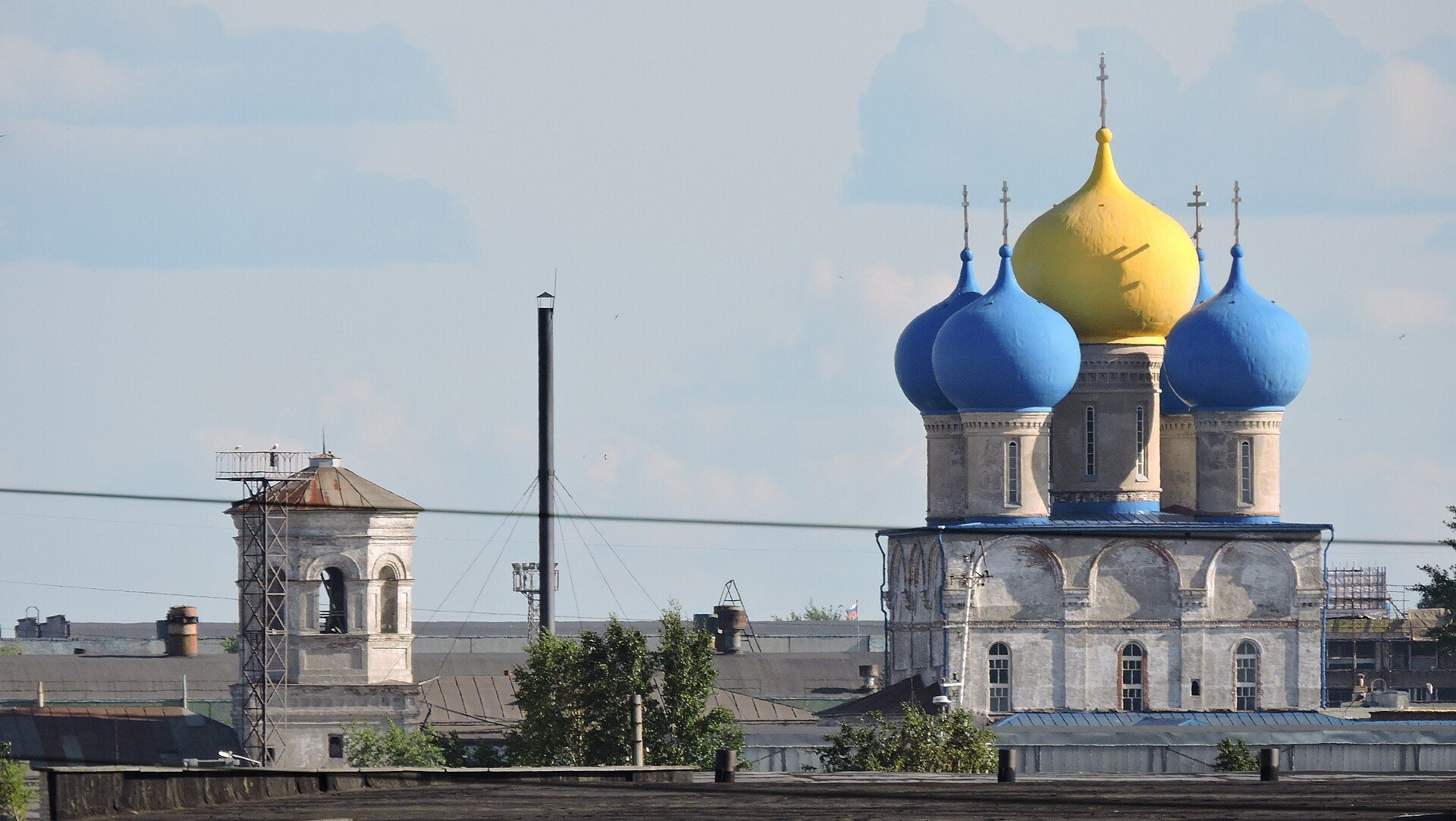
Saint Nicholas Cathedral was built between 1670 and 1674. Its five domes were lost in a fire in 1933, probably caused by lightning, and the dome drums were destroyed in 1936. Five steel domes and crosses were installed again in December 2009. The domes were made in Sevmash workshops, while the crosses were produced in another Sevmash workshop.
Assumption Church
The Assumption Church, also the monastery’s refectory church, was built between 1664 and 1667. The building survives, while its domes have been lost. It forms part of the stone complex erected during the monastery’s major seventeenth-century rebuilding.
Bell tower
The bell tower was built in 1700 and remains standing. Its tent roof has been lost.
Passage gallery and monastery building
A passage gallery built in 1684 connects the Assumption Church with Saint Nicholas Cathedral. The monastery building also survives. Some former ecclesiastical buildings remain physically integrated into the Sevmash industrial complex and continue to accommodate plant departments.
Enclosure and harbor landscape
Wooden enclosure and Holy Gates
In the late seventeenth century, a wooden wall with seven towers enclosed the monastery. Most of it was demolished during the twentieth century. The remaining small section included a gate tower incorporating the Holy Gates, the principal ceremonial entrance through a monastic enclosure. This gate tower was transported to the Kolomenskoye Museum in Moscow.
Former harbor and anchorage
The monastery stood beside the Nikolskoye estuary of the Northern Dvina. Opposite it, on Yagry Island, the former Saint Nicholas Roadstead included warehouses and residential buildings used to transfer cargo between sea-going vessels and river craft. The harbor area formed part of the maritime infrastructure that once connected the monastery with Kholmogory and the wider Russian river system.
Lost chapel
The Chapel of the Presentation of the Lord, dated to 1860, has been lost. The monastery’s surviving buildings are within the restricted Sevmash territory and are consequently not freely accessible to Orthodox worshippers or other visitors.