Fort Pilar: A Spanish Colonial Fortress and National Museum in the Philippines
Site at a Glance
- Rating
- 4.7
- Popularity
- Low
- Country
- Philippines
- Primary era
- Early Modern
- External website
- Open
- Eras represented
- Early Modern
- Civilizations
- Spanish
- Site type
- Military
- Remains
- Fort
On this page14 sections
History
Fort Pilar is a Spanish colonial military fortress in Zamboanga City, Philippines, built during the seventeenth century in a period of Spanish expansion and conflict in the southern Philippines. Formally called the Real Fuerte de Nuestra Señora del Pilar de Zaragoza and originally the Real Fuerte de San José, it defended Spanish settlements and missions while also protecting ships, sheltering residents, and serving as a prison.
Foundation and Spanish expansion
In 1635, Governor Juan Cerezo de Salamanca authorized a stone fort after a request from Jesuit missionaries and Bishop Fray Pedro of Cebu. Jesuit priest-engineer Melchor de Vera laid the cornerstone on June 23, 1635. The date is also treated as the founding date of Zamboanga City. Construction continued under Governor-General Sebastián Hurtado de Corcuera, with laborers from Cavite, Cebu, Bohol, and Panay working alongside Spanish, Mexican, and Peruvian workers.
The building project brought together people from different linguistic communities and was associated with the emergence of Zamboangueño Chavacano, a Philippine creole language with strongly Spanish-influenced vocabulary and grammar shaped largely by local languages. The fort was intended to counter pirates and raiders associated with the Sultanates of Maguindanao and Sulu, Muslim-ruled states in the southern Philippines.
Attacks, withdrawal, and rebuilding
The Dutch attacked the fort in 1646. Spanish troops later withdrew to Manila in 1662 and 1663 to help oppose Koxinga, a Chinese military commander. Fort Pilar was no longer held by Spanish troops during this withdrawal, and later destruction left it in need of rebuilding. The loss of the garrison was followed by increased raids, kidnappings, ship losses, insecurity affecting agriculture, and declining Spanish influence in the region.
Jesuit missionaries began rebuilding the fort in 1669 after further damage from pirates and raiders. In 1718 and 1719, engineer Juan Sicarra reconstructed it on the earlier foundations by order of Governor-General Fernando Manuel de Bustillo Bustamante y Rueda. The fortress was then renamed the Real Fuerte de Nuestra Señora del Pilar de Zaragoza after Our Lady of the Pillar, a Marian title associated with an apparition tradition at Zaragoza in Spain and with the patroness of Spain.
Military conflicts and religious traditions
In 1720, Rajah Dalasi, ruler of Butig, led approximately 3,000 Moro attackers against the fort, but the defenders repelled the assault. British naval forces bombarded it in 1798, and the fort again resisted. In 1872, seventy prisoners mutinied there.
An image or relief of Our Lady of the Pillar was installed above the eastern wall in 1734, creating an outdoor shrine. A local tradition places an appearance of the Virgin Mary before a soldier at the city gate on December 6, 1734. Another tradition, preserved in an account heard by Captain John H. McGee, places an apparition during a Dutch siege and connects it with a promise of victory for the garrison. The relationship between that tradition and the Dutch attacks remains uncertain.
Other traditions associate the shrine with protection during major disasters. Following the earthquake and tsunami threat of September 21, 1897, visionaries reportedly saw the Virgin Mary above Basilan Strait with her hand raised toward the waves. A similar apparition was reportedly seen over the sea during the tsunami-causing earthquake of August 19, 1976.
Revolution, war, and national preservation
During the Philippine Revolution, Spanish troops surrendered Fort Pilar to the Revolutionary Government of Zamboanga under General Vicente Álvarez on May 18, 1899. United States expeditionary forces captured it on November 19 of the same year. Japanese forces occupied the fort in 1942 during the Second World War, while United States and Filipino forces recaptured it in March 1945. The fort was formally transferred to the Republic of the Philippines on July 4, 1946.
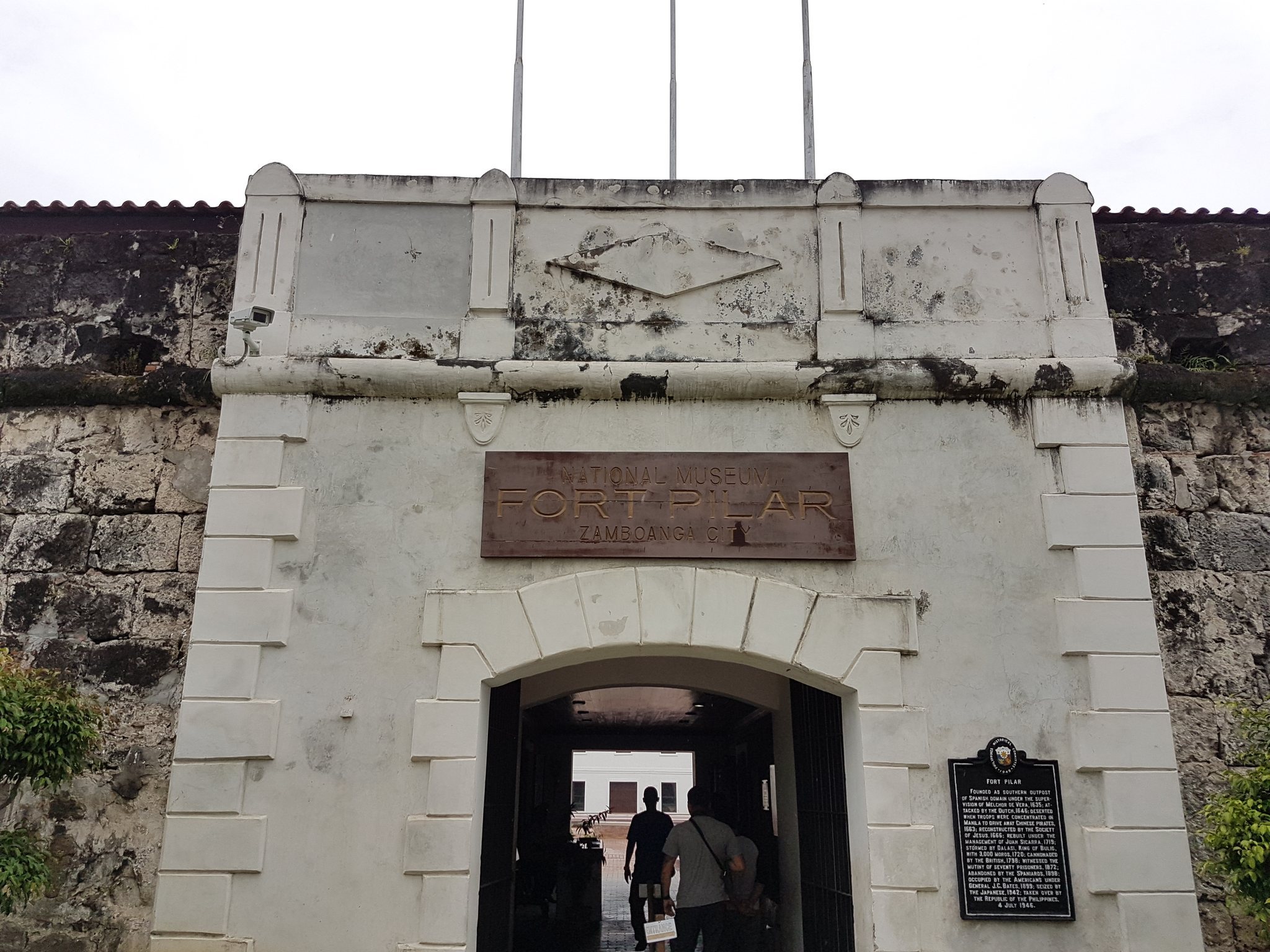
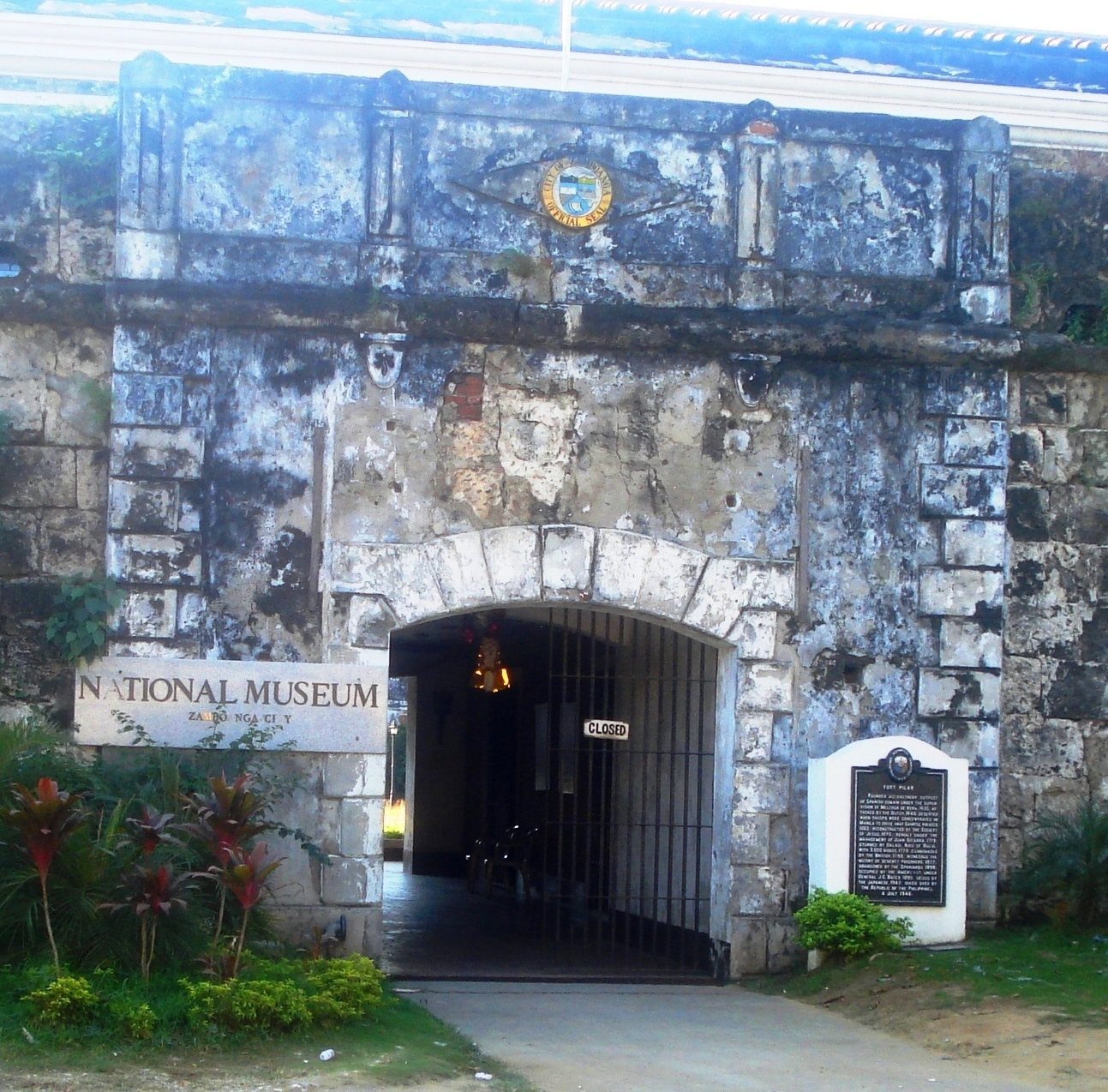
Fort Pilar was declared a National Cultural Treasure on August 1, 1973, under Presidential Decree No. 260. After wartime deterioration, the National Museum of the Philippines began restoration in the early 1980s and reconstructed three of the four structures inside the fort. The restored complex became a regional branch of the National Museum, the country’s state museum institution for archaeological, cultural, artistic, and natural-history collections.
The fort continues to serve both as an outdoor Roman Catholic Marian shrine and as a National Museum regional museum. Our Lady of the Pillar was pontifically crowned as Zamboanga’s patroness on October 12, 1960, following a papal decree of September 18, 1960. On October 8, 2025, the Archbishop of Zamboanga formally declared the shrine the Archdiocesan Shrine of Our Lady of the Pillar. Annual religious observances include processions from La Purisima Cathedral to the shrine from October 3 to 11, followed by Mass there.
Remains
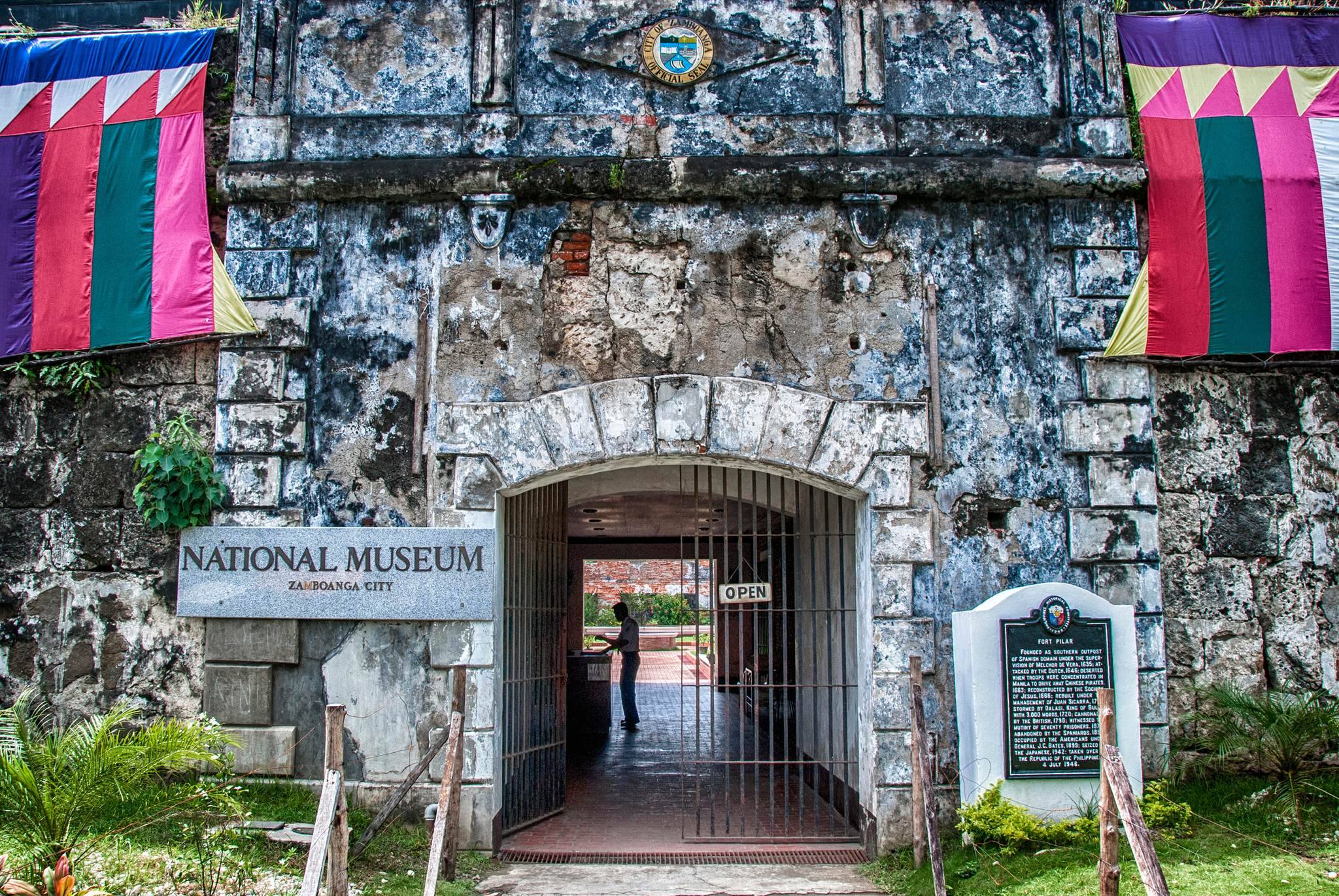
Fort Pilar is a masonry bastioned fort, meaning that projecting defensive works occupy its corners. It has a nearly square plan, four thick stone walls, and pointed corner bastions. The fortress was built on earthen embankments in a swampy, mangrove-covered area at the southern end of the Zamboanga Peninsula. Its position provided views toward Basilan and the Sulu Archipelago, while its interior accommodated Spanish officers, soldiers, and their families, together with a church, school, and hospital.
Walls, shrine, and interior structures
Main fortress
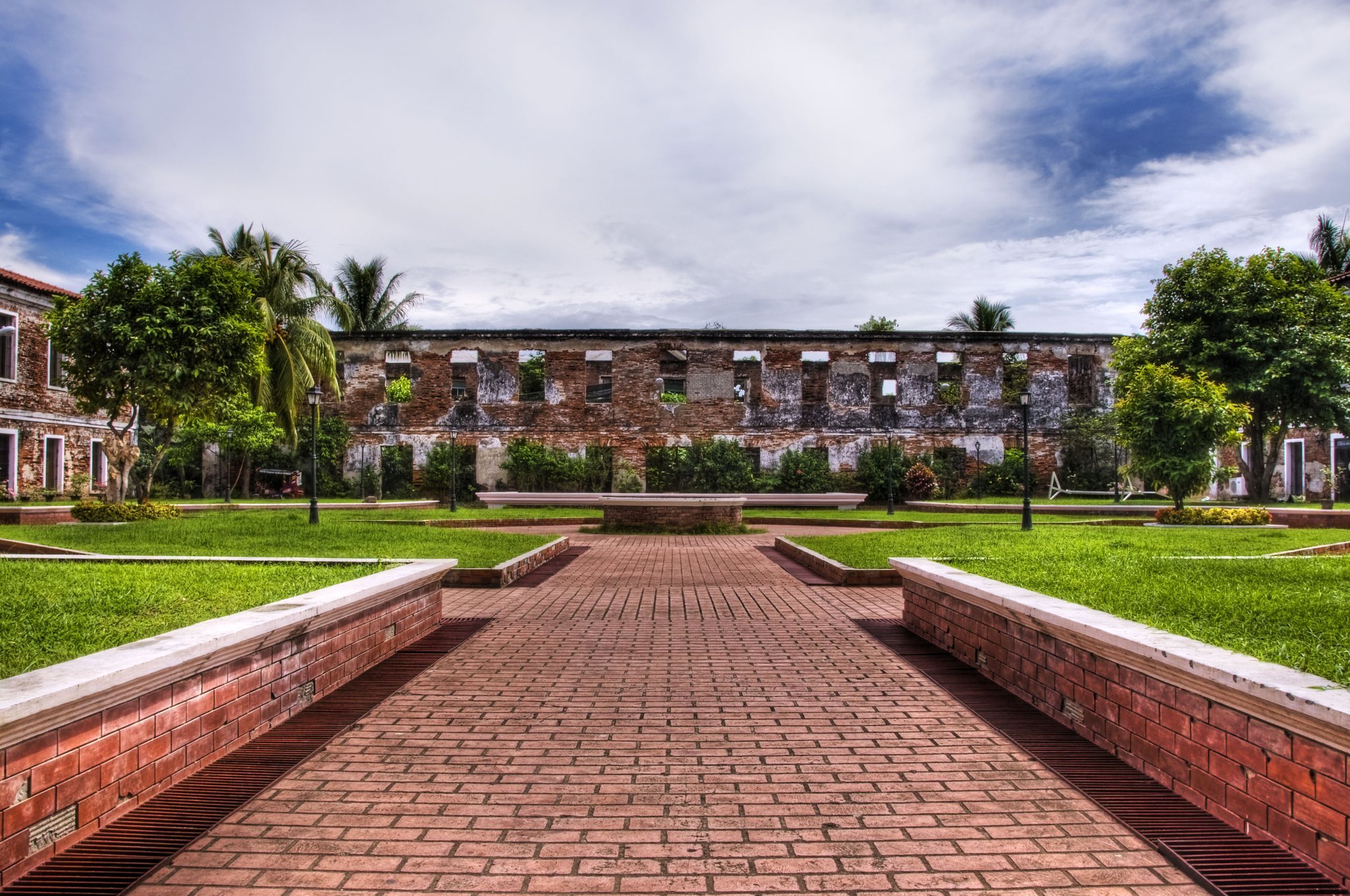
The main enclosure consists of four substantial stone walls arranged around an interior space. The fort originally contained four internal structures. Restoration reconstructed three of them, while the southern structure remains in ruins. Gardens are maintained inside and outside the walls. The reclaimed Paseo del Mar esplanade now protects the fort from the effects of the sea.
Eastern Marian shrine
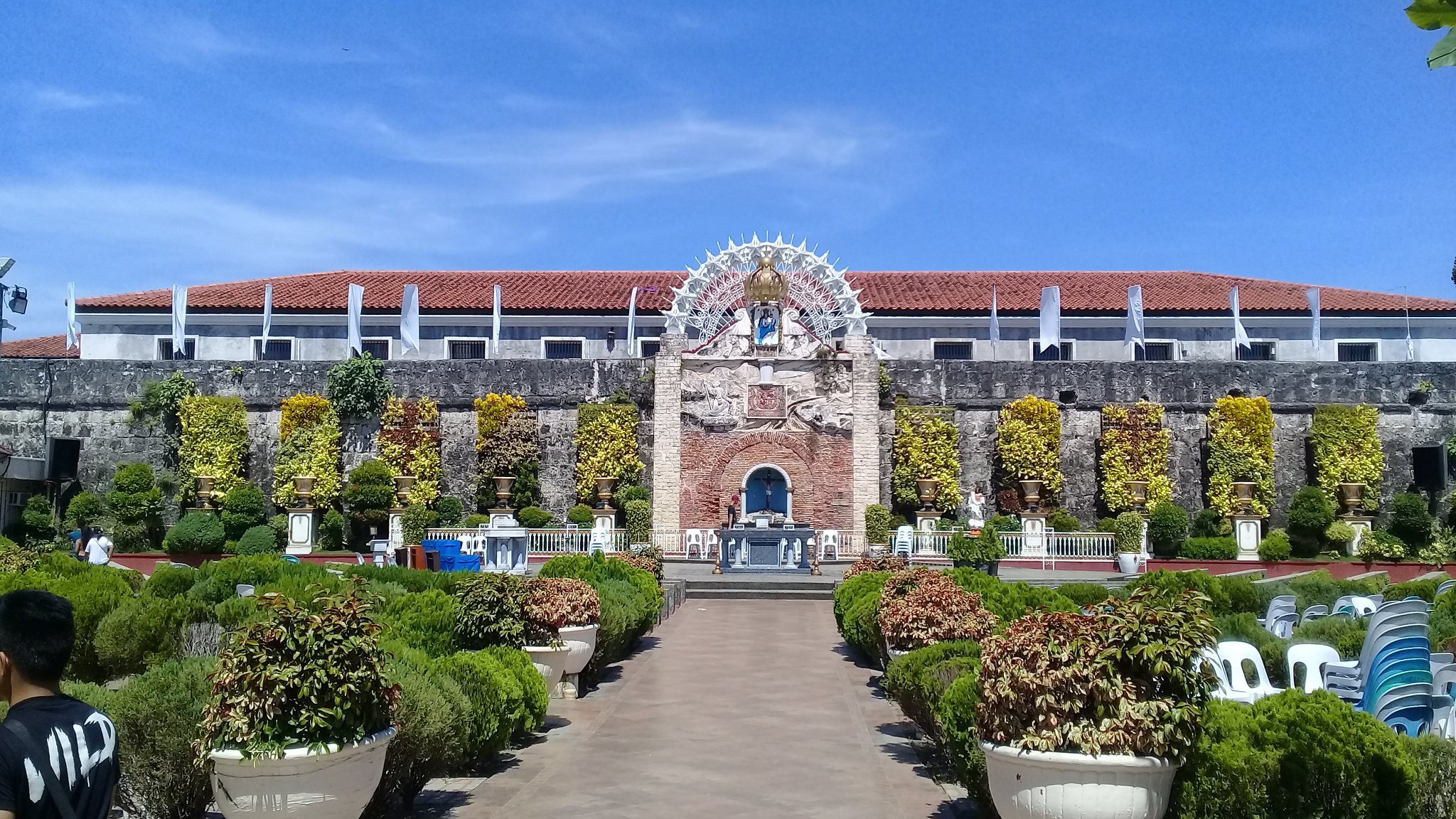
The eastern wall incorporates the outdoor Marian shrine. An image or relief of Our Lady of the Pillar stands above the former entrance area, and an altar occupies the former gateway. The shrine includes a gabled section with the Marian figure, a gilded crown beneath a decorative arch, and two inscriptions. A broad forecourt with seating extends before it. The shrine remains open to the sky and is visually distinct in color from the surrounding stone wall.
Restored museum structures
The second floor of Structure II hosted a marine-life exhibition that presented 400 species in large dioramas. The ground floor housed an exhibition of eighteenth-century relics recovered from the Griffin Shipwreck, an eighteenth-century vessel whose remains provide archaeological material for display within the museum complex.
Auxiliary defenses
La Caldera Fort
La Caldera Fort was restored in 1784 as an auxiliary fortification within the wider defensive system. It covered approximately 0.65 square meters and was built from large blocks of red coral stone, apparently brought from outside the immediate area.
Santa Barbara and Santa Catalina blockhouses
The blockhouses named Santa Barbara and Santa Catalina were originally linked to the main fort by a solid stone wall. The connecting wall and both blockhouses were later demolished after they were no longer needed.
Present museum collections
The fort is occupied by the regional museum of the National Museum of the Philippines. Its exhibitions include the cultures of the Subanen, Sama Badjao, and Yakan peoples, as well as regional marine life and botany. These museum functions coexist with the open-air shrine incorporated into the eastern wall.