Fort Orange: A Dutch and Portuguese Fortification in Brazil
Site at a Glance
- Rating
- 4.6
- Popularity
- Medium
- Country
- Brazil
- Primary era
- Early Modern
- External website
- Open
- Eras represented
- Early Modern
- Civilizations
- Dutch, Portuguese
- Site type
- Military
- Remains
- Fort
On this page8 sections
History
Fort Orange is a seventeenth-century Dutch fortification on Itamaracá Island in Brazil, built during the Dutch occupation of northeastern Brazil. Construction began in May 1631 under Steyn Callenfels, following designs by the engineer Pieter van Bueren. Named for the House of Orange-Nassau, the ruling dynasty of the Dutch Republic, the fort controlled the southern entrance to the Santa Cruz channel and the principal harbor of Itamaracá.
Dutch Foundation and Expansion
The first fort stood on a low sandbank or small island in front of southeastern Itamaracá Island. A narrow channel separated it from the larger island, although the crossing could be made at low tide. The original structure used branches and rammed earth, and its position allowed the garrison to control vessels entering the harbor.
A garrison of 366 men served under the Polish captain Krzysztof Arciszewski. Portuguese forces attacked in 1632 but were defeated and withdrew, leaving four bronze cannon taken from Arraial Velho do Bom Jesus. The fort was then repaired and enlarged, helping to support the Dutch conquest of Itamaracá in 1633.
Under Johan Maurits, the ditch was deepened and defensive timber fences, known as palisades, were erected. These defenses were strengthened around 1639 in preparation for a possible Spanish fleet attack. In 1640, two companies totaling about 182 men occupied the fort, which also held several Portuguese friars imprisoned for opposing the spread of Calvinism.
Portuguese Counteroffensive and Reconstruction
During the Portuguese counteroffensive on Itamaracá in June 1646, forces led by André Vidal de Negreiros and João Fernandes Vieira assigned Sergeant-Major Antônio Dias Cardoso to attack the Dutch positions with eighteen cannon. Whether the fort was temporarily captured remains uncertain, but it suffered heavy damage and required rebuilding from 1649.
After the Dutch capitulation at Recife in 1654, Portuguese forces occupied the abandoned fort under Colonel Francisco de Figueiroa. It was renamed the Fort of Santa Cruz de Itamaracá and reconstructed as a Portuguese military installation. Repairs followed in 1696, 1777, and 1800. The fort was later abandoned and fell into ruin, although it was restored again in 1817 when forces led by Father Tenório occupied it during the Pernambuco Revolution.
Later Military Use and Preservation
The fort continued to be used by independent Brazil during the nineteenth century before losing its strategic function. Brazil declared it National Historic Heritage in 1938. Consolidation and restoration followed in 1966 and 1973, while archaeological work by the Archaeology Laboratory of the Federal University of Pernambuco began in 1971.
In the early 1980s, the Department of the Army began further reforms. Administration passed to the Municipality of Itamaracá in 1984. José Amaro de Souza Filho maintained and stored the freestanding monument until 1992, with some support from craft sales, and founded the Fort Orange Foundation in 1991. The foundation administered the fort until 1998, after which management passed successively to the municipality, the Ministry of Culture, and the Foundation for the Support of the Development of the Federal University of Pernambuco.
Remains
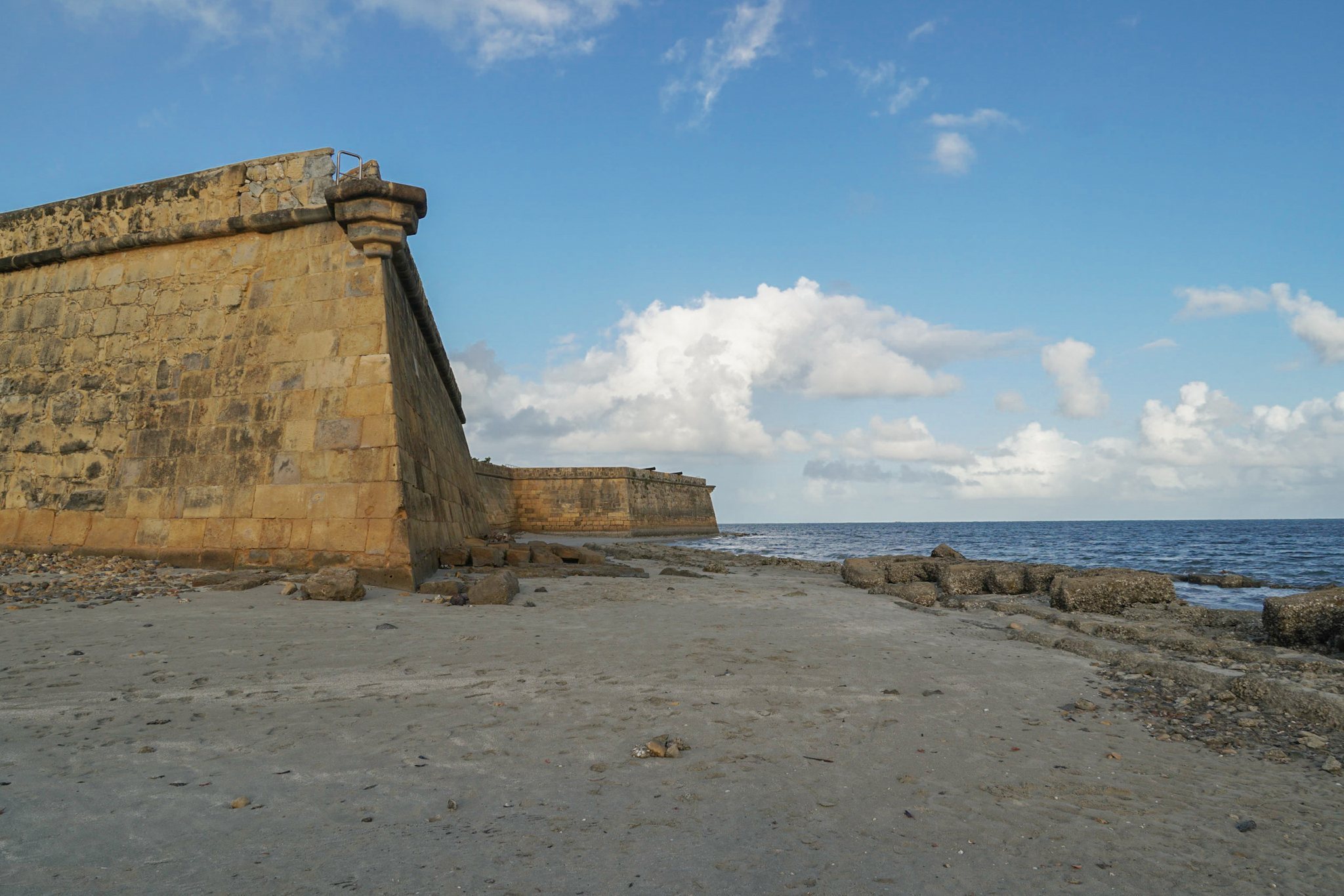
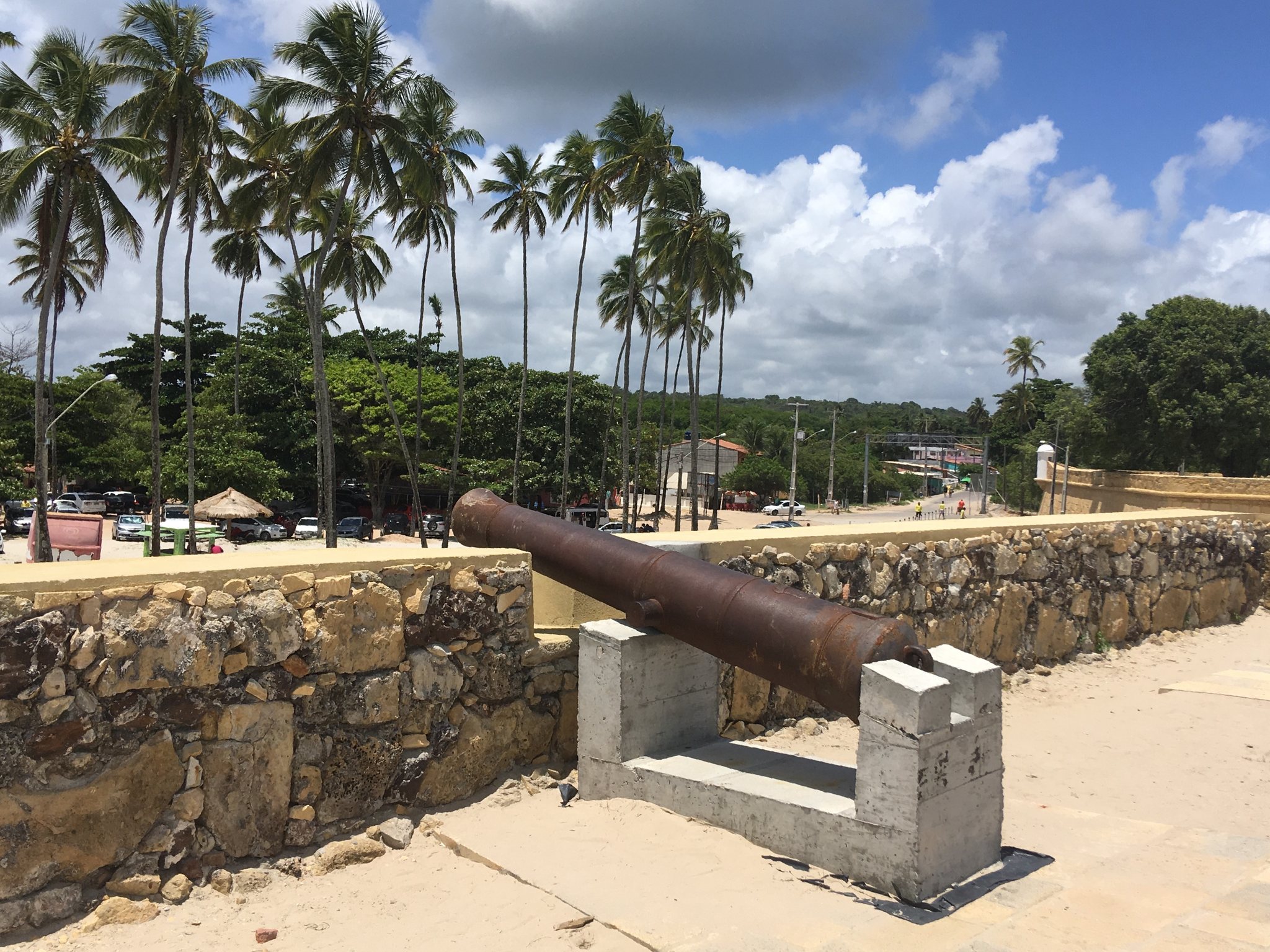
Fort Orange occupies a low position on Itamaracá Island at the southern entrance to the Santa Cruz channel and harbor. Its surviving form reflects a Portuguese reconstruction in stone masonry and lime, while archaeological excavations have revealed remains of the earlier Dutch fort beneath or within the later military complex. The fort is in good condition following consolidation, restoration, and archaeological work.
The Dutch Fortification
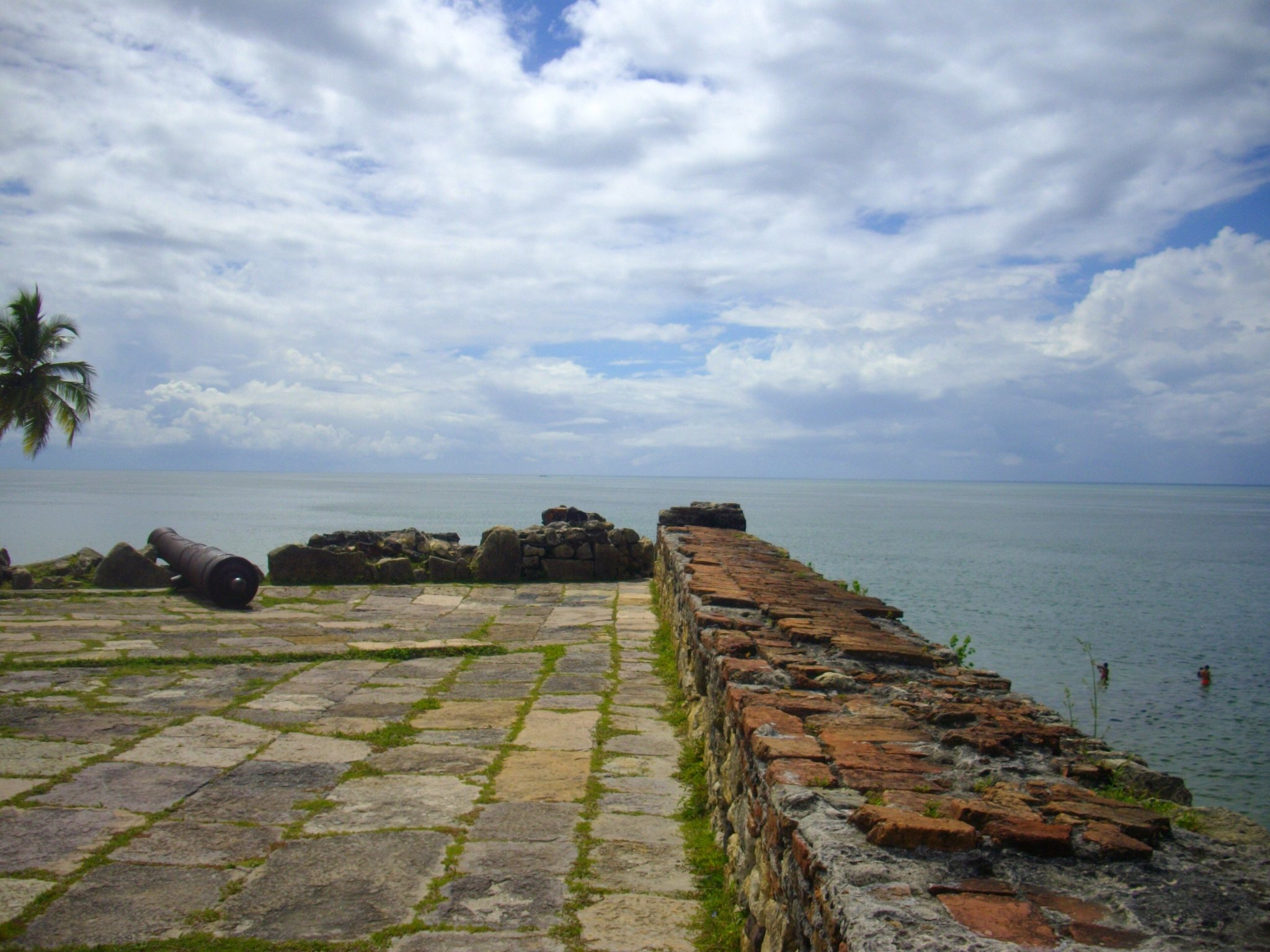
The original Dutch fort was square, with a projecting bastion at each corner. Bastions allowed defenders to direct fire along the adjoining walls. A ditch and surrounding palisade protected the position, although contemporary descriptions differ over the ditch’s form, with one describing it as relatively shallow and dry and another noting the need for additional counterscarp work along its outer edge. In 1640, the fort mounted twelve cannon, including six bronze and six iron pieces. The bronze guns ranged from 26- to 6-pound caliber, while the iron armament comprised two 5-pound and four 4-pound cannon.
The Portuguese Reconstruction
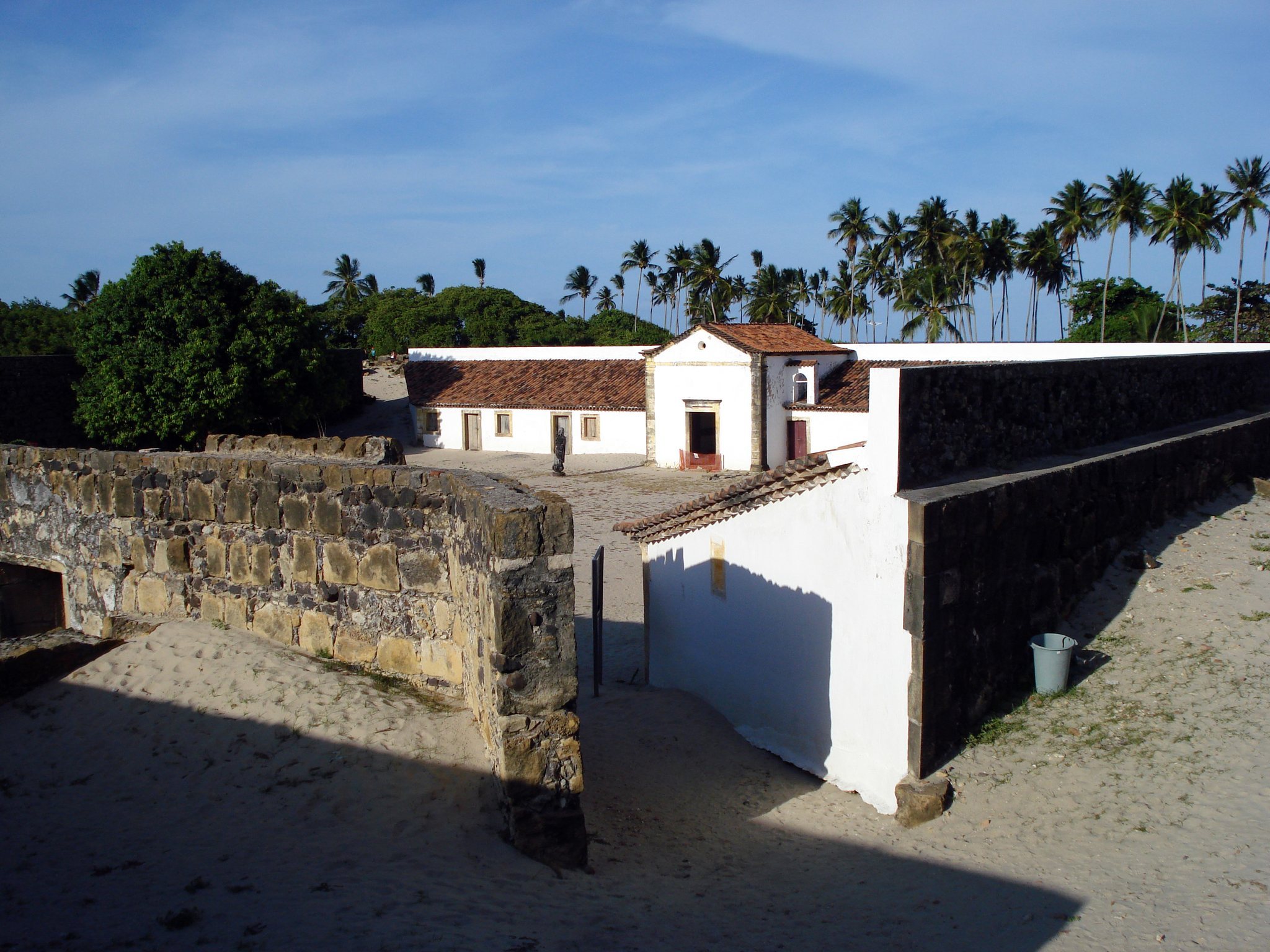
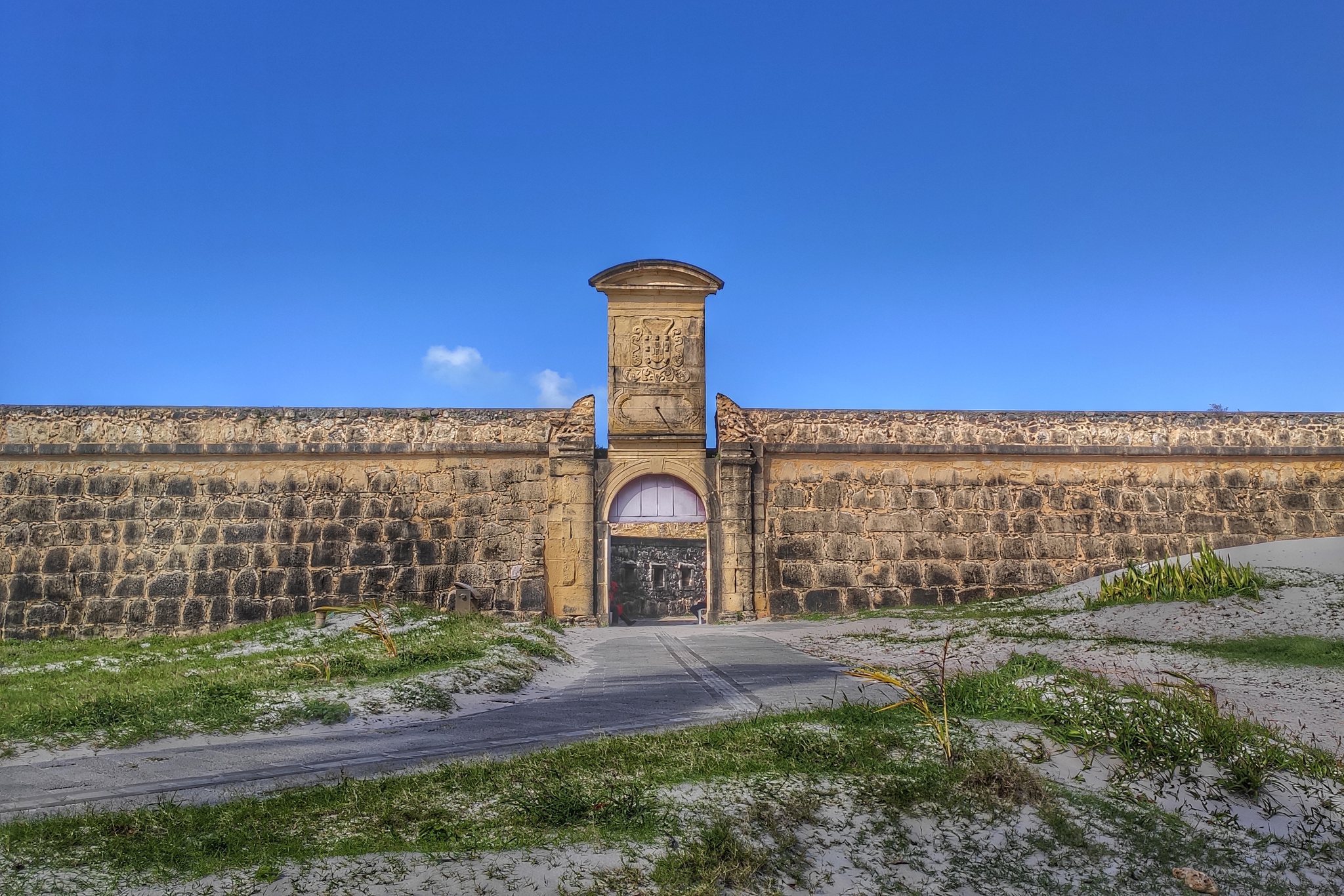
The Portuguese rebuilding created a quadrangular polygon with regular pentagonal corner bastions. Its stone defenses included small projecting structures known as bartizans, a fortified gate bearing an armorial design, troop barracks, and protected chambers called casemates beneath the walls. The reconstruction followed fortification methods associated with Sébastien Le Prestre de Vauban, the French military engineer whose bastioned system influenced European fortress design. New quarters, a commander’s house, ammunition stores, strengthened gateways, and additional bartizans were added. After the 1696 repairs, the fort was recorded as carrying twenty-five cannon, while twenty-three were reported after the 1817 restoration.
Archaeological Remains
Archaeological investigations identified the locations or remains of the kitchen, chapel, rooms, and casemates. Excavations recovered pottery, weapons, ammunition, food remains, and objects used by the fort’s occupants. Campaigns in 2002 and 2003 revealed further remains of the original Dutch fort, and the recovered archaeological material was incorporated into a museum established as part of the restoration work.